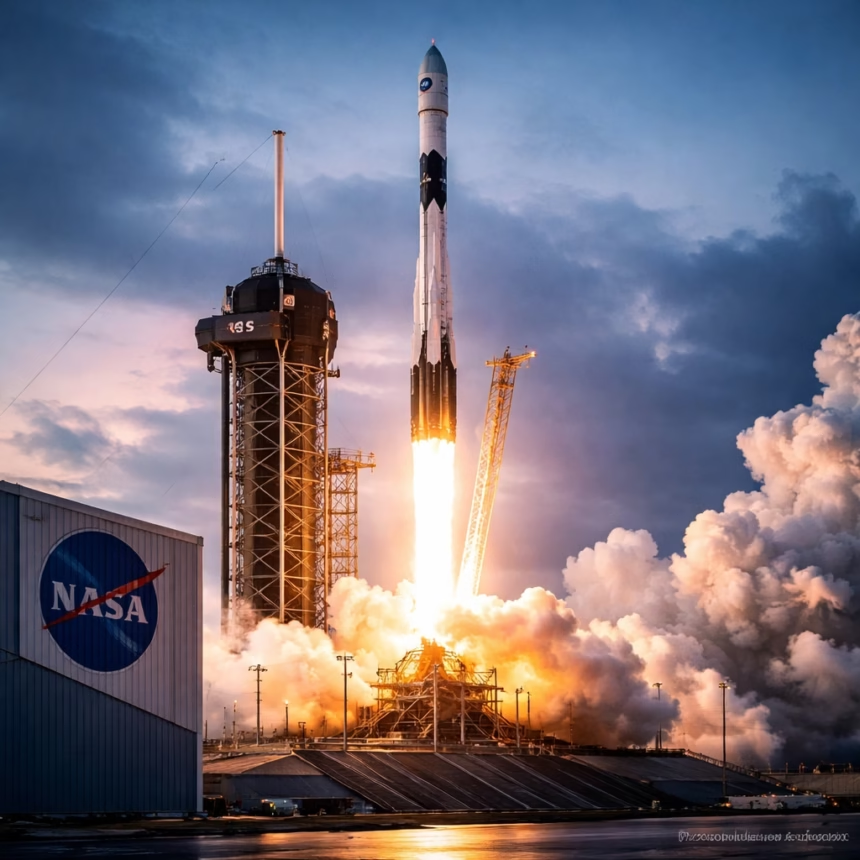
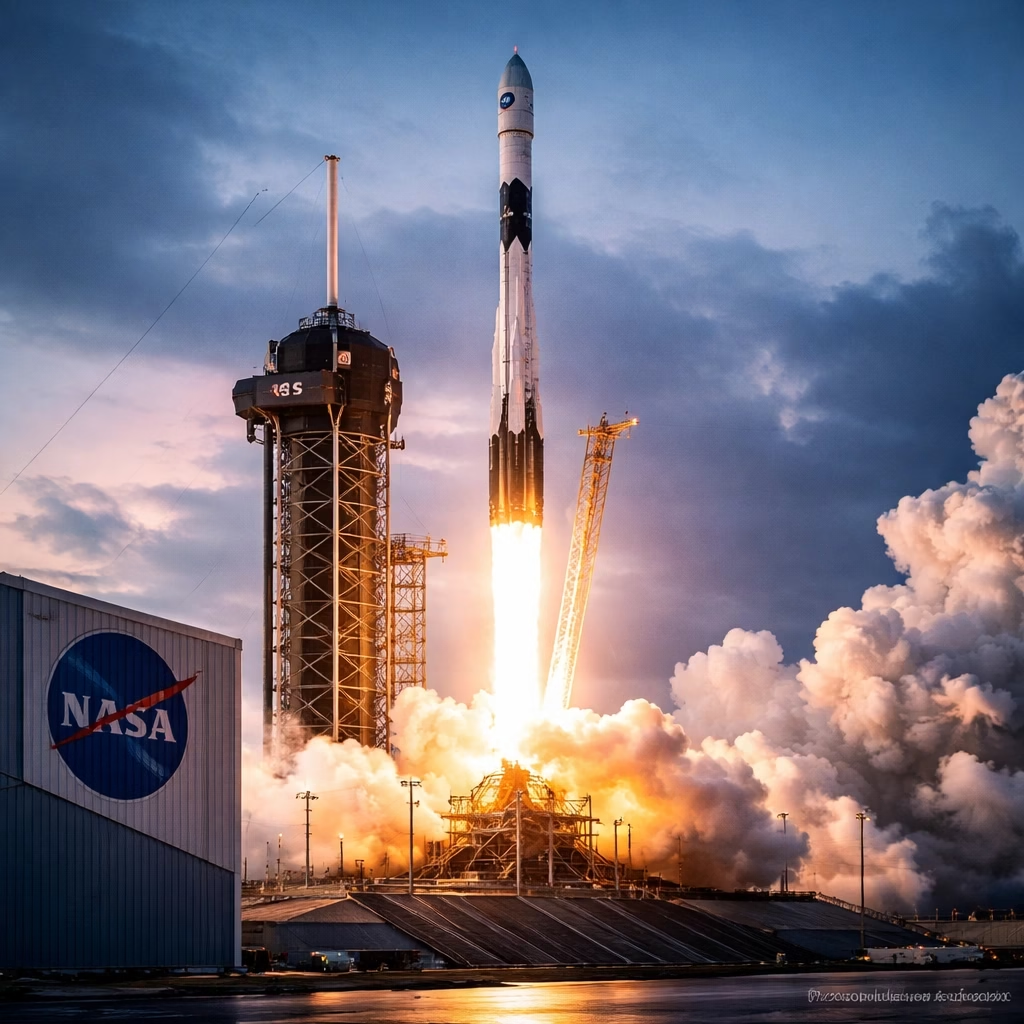
A SpaceX Falcon 9 rocket successfully launched the company's 34th commercial resupply services (CRS) mission for NASA, delivering a vital payload of scientific experiments, crew supplies, and critical hardware to the International Space Station (ISS). The mission, designated CRS-34, lifted off from Space Launch Complex 40 (SLC-40) at Cape Canaveral Space Force Station in Florida during the early morning hours of [Insert Plausible Date, e.g., May 15, 2025], marking another milestone in commercial space transportation.
Background: A Decade of Commercial Resupply
The partnership between NASA and commercial providers like SpaceX has revolutionized access to low Earth orbit. NASA’s Commercial Resupply Services (CRS) program was established to ensure a reliable and cost-effective means of transporting cargo to the International Space Station after the Space Shuttle program concluded. SpaceX, with its Falcon 9 rocket and Dragon spacecraft, became one of the primary partners, initiating its first resupply mission in 2012.
Over the past decade, SpaceX's Dragon spacecraft, initially the Dragon 1 and later the more advanced Cargo Dragon (Dragon 2), has become a workhorse for ISS logistics. These missions not only deliver essential supplies for the crew but also transport a continuous stream of scientific investigations, enabling groundbreaking research in microgravity. The reusability of the Falcon 9's first stage, which typically lands back at Cape Canaveral's Landing Zone 1 or on an autonomous drone ship in the Atlantic, further enhances the efficiency and sustainability of these missions. The ISS itself serves as humanity's orbiting laboratory, a unique platform for international collaboration and scientific discovery that cannot be replicated on Earth.
Key Developments: CRS-34’s Scientific Payload
The CRS-34 mission carries approximately 6,800 pounds (3,085 kilograms) of cargo, a significant portion of which is dedicated to advanced scientific research. This diverse array of experiments aims to push the boundaries of knowledge in biology, physical sciences, and technology development, with direct applications for human health on Earth and future deep-space exploration. The Cargo Dragon spacecraft is expected to autonomously dock with the ISS within two days of launch, where the station’s crew will begin the meticulous process of unloading and activating the precious cargo.
More Read

Revolutionizing Human Health in Space
Among the key biological investigations is the Microgravity Bone Density Study (MBDS-3), an ongoing effort to understand and mitigate bone loss experienced by astronauts during long-duration spaceflight. This iteration focuses on novel countermeasures, including pharmaceutical interventions and advanced exercise regimens, building upon data from previous missions. Another crucial payload is the Astro-Microbiome Mapping (AMM) experiment, which will meticulously map the microbial environment of the ISS and the human microbiome of its crew. Understanding these interactions is vital for maintaining crew health and preventing contamination during future missions to the Moon and Mars.
Advancements in Materials Science and Manufacturing
The physical sciences payload includes the Advanced Material Science Rack (AMSR), designed to investigate the properties of new alloys and composite materials under microgravity conditions. Researchers hope to discover materials with enhanced strength, durability, and heat resistance that could revolutionize industries on Earth, from aerospace to automotive. Furthermore, the In-Space Additive Manufacturing Demo (ISAMD) represents a significant step towards autonomous in-space manufacturing. This experiment will test the feasibility of 3D printing complex structures using recycled materials onboard the ISS, potentially reducing the need for costly resupply missions for spare parts and tools.
Sustainable Living and Earth Observation
For sustainable living in space, the mission includes the Bio-Regenerative Life Support System (BRLSS) Mk-II, an advanced plant growth system designed to test new hydroponic techniques and nutrient delivery methods. This research is critical for developing closed-loop life support systems essential for lunar bases and Martian habitats. Additionally, an external payload, the Atmospheric Composition Mapper (ACM), will be robotically installed on the ISS exterior. This instrument will provide enhanced data on Earth’s atmospheric gases, contributing to climate change research and improving weather prediction models.

Impact: Broadening Horizons for Humanity
The successful delivery and implementation of the CRS-34 cargo will have far-reaching impacts across multiple sectors. For the astronauts aboard the ISS, the new supplies ensure their continued well-being and productivity, while the experiments provide engaging and vital work. Scientists worldwide gain unprecedented access to the microgravity environment, allowing them to conduct research impossible on Earth and generate data that can lead to breakthroughs in medicine, materials science, and fundamental physics.
The insights gleaned from experiments like MBDS-3 and AMM are directly applicable to improving human health on Earth, particularly in areas related to osteoporosis, immunology, and infectious diseases. The material science and manufacturing demonstrations could spur innovation in terrestrial industries, creating new jobs and economic opportunities. Moreover, the BRLSS Mk-II and ISAMD experiments are foundational to NASA's Artemis program, which aims to return humans to the Moon, and future crewed missions to Mars. By proving technologies for sustainable living and in-space production, CRS-34 is directly contributing to humanity's ability to live and work beyond Earth. The mission also reinforces the robust capabilities of the commercial space industry, fostering competition and innovation that benefits all spacefaring nations.
What Next: Dragon’s Return and Future Endeavors
Following its arrival and the extensive unloading process, the Cargo Dragon spacecraft will remain berthed at the ISS for approximately one month. During this period, the crew will load the spacecraft with completed scientific experiments, unneeded equipment, and trash for disposal. Once its mission is complete, Dragon will undock from the ISS and perform a deorbit burn, culminating in a parachute-assisted splashdown in the Atlantic Ocean off the coast of Florida. The retrieved cargo, particularly the sensitive scientific samples, will then be transported to NASA’s Kennedy Space Center for analysis by researchers.
Looking ahead, the success of CRS-34 reinforces the reliability of the commercial resupply model. NASA anticipates further CRS missions, including CRS-35 and beyond, continuing the vital lifeline to the ISS. The scientific data collected from the CRS-34 experiments will be analyzed for months and years to come, feeding into future research proposals and technological developments. This continuous cycle of launch, research, and return is fundamental to maximizing the scientific return from the International Space Station and paving the way for the next era of human exploration and discovery in the cosmos.