US Unleashes 'Decisive Strikes' on Iran-Linked Targets Across Middle East
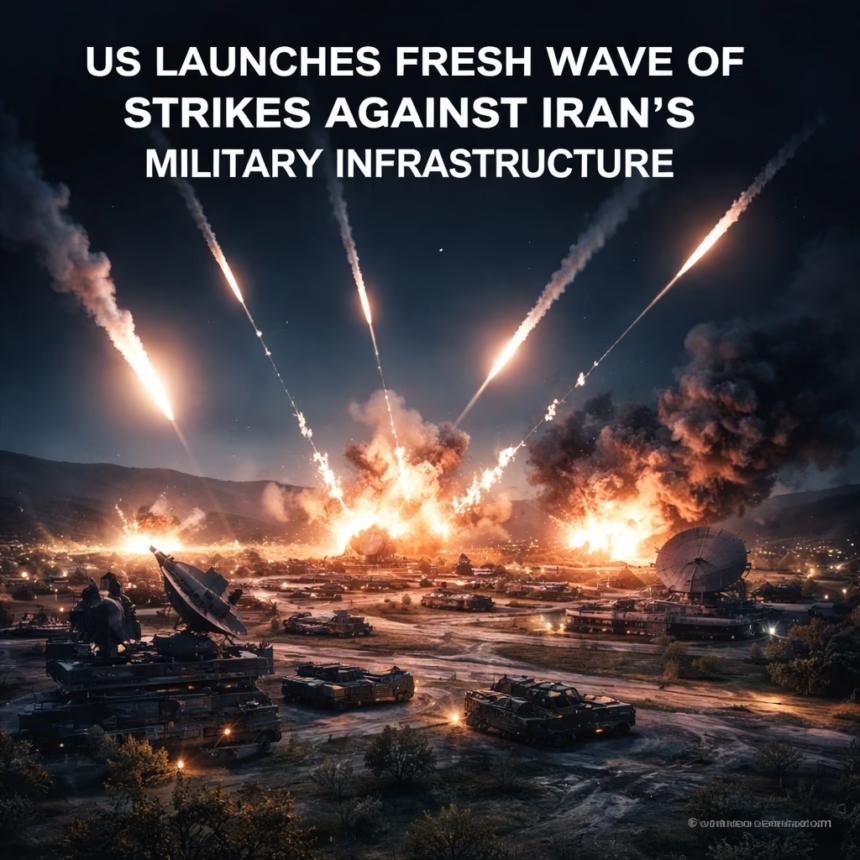
The United States military has launched a significant new wave of airstrikes targeting military infrastructure linked to Iran and its proxy groups across the Middle East. These extensive operations, primarily conducted over the weekend of February 2-3, 2024, struck dozens of sites in Iraq, Syria, and Yemen, marking a substantial escalation in the ongoing regional tensions.
Background: A Region on Edge
The recent military actions by the United States come amidst a prolonged period of heightened instability across the Middle East, a situation dramatically intensified since the October 7, 2023, attacks in Israel and the subsequent conflict in Gaza. This period has seen a dramatic increase in attacks on US personnel and assets, as well as critical international shipping lanes.
For months, Iran-backed militia groups operating in Iraq and Syria have launched numerous drone and rocket attacks against US military bases and diplomatic facilities. These incidents, numbering over 160 since mid-October, have resulted in dozens of injuries to American service members, ranging from concussions to more severe wounds.
More Read

Simultaneously, Yemen's Houthi rebels, also supported by Iran, have intensified their assaults on commercial vessels and naval ships in the Red Sea and Gulf of Aden. These attacks, often involving anti-ship missiles and drones, have disrupted global trade routes, forcing major shipping companies to reroute vessels around Africa, significantly increasing costs and transit times.
A critical turning point occurred on January 28, 2024, when a drone attack on Tower 22, a small US military outpost in northeastern Jordan near the Syrian border, resulted in the deaths of three American soldiers—Sergeant William Jerome Rivers, Specialist Kennedy Ladon Sanders, and Specialist Breonna Alexsondria Moffett. The attack also injured more than 40 others, marking the first US fatalities from hostile fire in the region since the Gaza conflict began.
President Joe Biden swiftly vowed a response, stating that the US would "hold all those responsible to account at a time and in a manner of our choosing." This pledge set the stage for the extensive retaliatory strikes that followed.
More Read

Key Developments: A Coordinated Response
The recent wave of US military operations represented a comprehensive and multi-pronged response to the escalating threats. On February 2, 2024, US forces, supported by B-1B long-range bombers flying from the United States, struck over 85 targets across seven locations in Iraq and Syria. These targets were identified as facilities used by Iran's Islamic Revolutionary Guard Corps (IRGC) Quds Force and associated militia groups.
Targets in Iraq and Syria
The strikes in Iraq and Syria focused on command and control operations centers, intelligence centers, rocket and missile storage facilities, drone storage sites, and logistics and munition supply chain facilities. Among the groups explicitly targeted were Kata’ib Hezbollah and other Iran-backed militias deemed responsible for attacks on US personnel.
US Central Command (CENTCOM) confirmed the precision nature of these strikes, asserting that they aimed to degrade the capabilities of these groups to launch further attacks. Preliminary assessments indicated significant damage to the targeted infrastructure.
Operations Against Houthi Rebels in Yemen
Concurrently, US and British forces launched a separate series of strikes against Houthi targets in Yemen. On February 3, 2024, these coalition forces struck 36 Houthi targets across 13 locations. These operations specifically aimed at Houthi underground weapon storage facilities, missile systems, launchers, air defense systems, and radar sites that have been instrumental in their attacks on Red Sea shipping.
These strikes followed earlier, more limited actions against Houthi capabilities in January, signaling a sustained effort to degrade their ability to threaten international maritime navigation. The Pentagon emphasized that these actions were taken in self-defense and to protect the free flow of commerce.
Official Statements and International Reaction
Following the strikes, President Biden reiterated that the US does not seek conflict in the Middle East but will not hesitate to defend its personnel. Secretary of Defense Lloyd Austin affirmed that this was “the start of our response” and warned that the US would take “all necessary actions” to defend its interests.
More Read

Iran, through its foreign ministry, condemned the strikes as a “strategic mistake” by the US and denied any direct role in the attack on Tower 22, asserting that resistance groups in the region act independently. Iraqi authorities also condemned the strikes on their territory, calling them a violation of sovereignty and a destabilizing factor.
Impact: Ripple Effects Across the Region and Beyond
The extensive nature of the US and allied strikes carries significant implications for the military landscape, geopolitical stability, and economic outlook of the Middle East and the wider world.
Military and Security Implications
Militarily, the strikes are intended to degrade the operational capabilities of Iran-backed groups, potentially reducing the frequency and lethality of attacks on US forces and international shipping. However, these groups possess resilient and adaptable networks, and a complete cessation of attacks is unlikely without a broader shift in regional dynamics.
The strikes also serve as a clear message of deterrence, signaling US resolve to protect its personnel and interests. Yet, there is an inherent risk that such actions could provoke further retaliation, leading to a dangerous cycle of escalation.
Geopolitical Ramifications
Geopolitically, the situation has become even more precarious. The strikes have intensified the proxy conflict between the US and Iran, raising concerns about a direct confrontation. Regional powers like Saudi Arabia, the UAE, and Israel are closely monitoring developments, with varying degrees of concern regarding the potential for wider conflict.
Iraq, caught between its alliance with the US and the influence of Iran-backed militias, faces significant internal and external pressure. The strikes on Iraqi soil complicate the US military presence in the country and could fuel anti-American sentiment.
Economic Repercussions
The ongoing instability, particularly in the Red Sea, continues to exert pressure on global supply chains and energy markets. Rerouting ships around the Cape of Good Hope adds weeks to transit times and significantly increases fuel costs, impacting consumer prices worldwide.
Oil prices, sensitive to Middle East tensions, could see further volatility if the situation escalates. Any disruption to oil production or shipping through critical chokepoints like the Strait of Hormuz, a key conduit for global oil supplies, would have severe economic consequences.
What Next: Navigating a Perilous Path
The path forward for the Middle East remains fraught with uncertainty, with several potential trajectories depending on the responses of key actors.
US Strategy and Deterrence
The US administration has stated its intention to continue a strategy of deterrence, combining military responses with diplomatic efforts. This could involve further targeted strikes if attacks against US forces or interests persist. However, the long-term effectiveness of military action alone in deterring asymmetric threats is a subject of ongoing debate.
Washington will likely continue to seek international cooperation to address Houthi aggression in the Red Sea and to de-escalate tensions with Iran, though the latter remains a complex challenge given the deep-seated animosity.
Iran and its Proxies’ Response
Iran and its network of proxy groups face a critical decision point. They could choose to escalate further, launching more sophisticated attacks in retaliation, or they might opt for a more cautious approach to avoid a direct, full-scale conflict with the US. The rhetoric from Tehran suggests continued support for “resistance” groups but also a desire to avoid direct engagement.
Militias in Iraq and Syria may continue their attacks, albeit potentially with modified tactics, seeking to avoid detection or present a more ambiguous threat. The Houthis, despite suffering significant blows to their capabilities, have also demonstrated resilience and a willingness to continue their Red Sea campaign.
Regional and International Diplomacy
The international community, including the United Nations and European Union, has largely called for de-escalation and restraint from all parties. Diplomatic efforts will be crucial in preventing the current situation from spiraling into a wider regional war. However, the effectiveness of such diplomacy is often limited when core national security interests are perceived to be at stake.
The ongoing conflict in Gaza remains a central driver of regional instability. Any progress towards a resolution there could significantly ease tensions elsewhere, while continued conflict risks further exacerbating the proxy wars.
As the Middle East navigates this perilous period, the balance between deterrence and de-escalation will define the immediate future, with the risk of miscalculation looming large over every decision made by Washington, Tehran, and their respective allies.