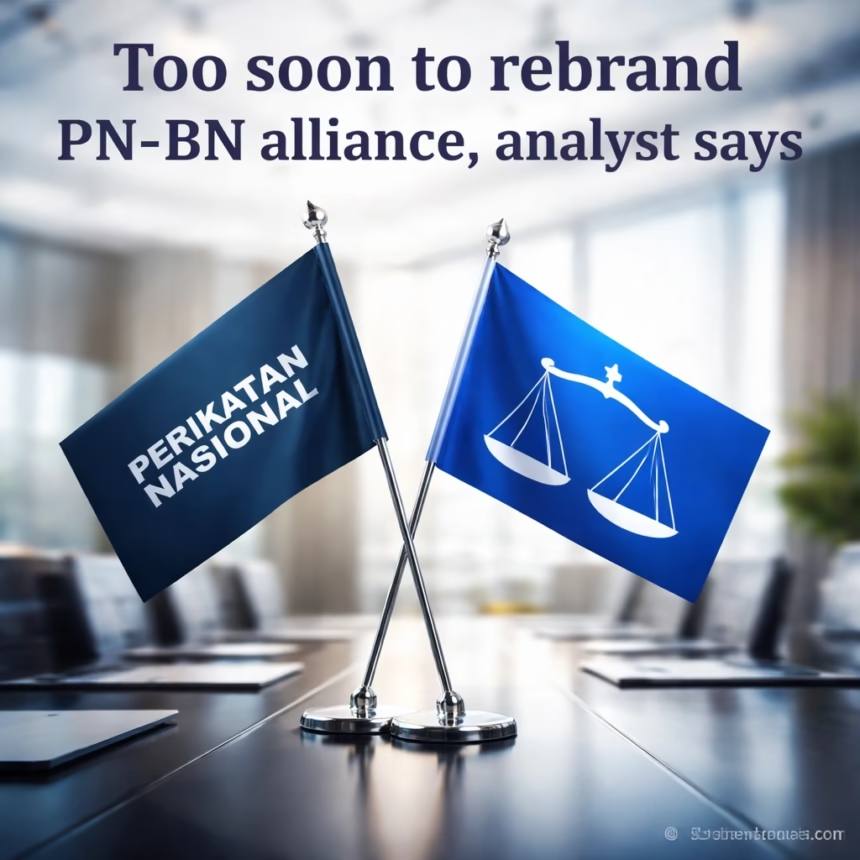
A prominent political analyst has issued a cautionary note regarding any immediate attempts to rebrand the Perikatan Nasional (PN) and Barisan Nasional (BN) alliance in Malaysia. The warning comes amidst swirling speculation about potential strategic shifts within the nation's complex political landscape, suggesting that such a move might be ill-timed given current sentiments and political realities. This perspective highlights the intricate calculations at play as parties navigate future electoral challenges and public perception.
Background: A Shifting Political Landscape
For decades, Barisan Nasional (BN), anchored by the United Malays National Organisation (UMNO), dominated Malaysian politics, shaping the nation's trajectory since independence in 1957. Its formidable electoral machine, comprising component parties like MCA and MIC, provided stability for over sixty years until its unprecedented defeat in the 14th General Election (GE14) in 2018. This historic shift ushered in a new era of dynamic coalition politics.
The subsequent political upheaval, famously dubbed the 'Sheraton Move' in February 2020, led to the formation of Perikatan Nasional (PN). This new coalition, spearheaded by Parti Pribumi Bersatu Malaysia (Bersatu) and including the Islamist party PAS, briefly held the reins of power. PN positioned itself as a defender of Malay and Islamic interests, rapidly consolidating support among segments of the electorate, particularly in the northern Malay-majority states.
The relationship between BN and PN has been complex, oscillating between cooperation and fierce rivalry. While they share similar voter bases and, at times, common ideological ground, their paths diverged sharply after GE14. BN eventually joined the Pakatan Harapan (PH)-led Unity Government post-GE15 in November 2022, with PN assuming the role of the primary opposition bloc. Despite this current adversarial stance, the concept of a broader 'Malay unity' or a grand coalition encompassing elements from both BN and PN has periodically surfaced in political discourse, fueled by various factions advocating for a consolidation of Malay-Muslim political power. The analyst's caution directly addresses the prudence of formalizing and rebranding such a hypothetical future grand coalition.

Key Developments Fueling Rebrand Talk
Recent political developments have intensified discussions around potential realignments and the necessity of strategic overhauls. The August 2023 state elections, for instance, saw Perikatan Nasional make significant inroads, particularly in the Malay-majority states of Kedah, Kelantan, and Terengganu, solidifying its position as a formidable force. PN's clean sweep in these states, coupled with strong performances in others, underscored its growing influence in the Malay heartland.
Conversely, Barisan Nasional, despite being part of the ruling Unity Government, faced considerable challenges during the same state elections. The coalition, particularly UMNO, lost ground in several traditional strongholds, raising questions about its long-term viability and appeal among its core constituents. This electoral performance has reportedly triggered introspection within BN, prompting discussions regarding its future direction and potential strategic partnerships.
Speculation has mounted about internal pressures within UMNO for a strategic overhaul, potentially including a re-evaluation of its alliances or a complete rebranding to recapture lost voter confidence. For PN, the strong showing has emboldened its leaders, yet also presented the challenge of broadening its appeal beyond its core base to form a truly national government.
More Read

Furthermore, the ongoing internal dynamics within UMNO, including debates over leadership and the party's direction within the Unity Government, contribute to the narrative. Some factions within the broader Malay political spectrum reportedly advocate for a 'grand coalition' that could unify Malay-Muslim political forces, seeing a rebranded PN-BN entity as a pathway to consolidate power ahead of the next general election, constitutionally due by 2028. This perceived need for consolidation, driven by electoral performance and internal party pressures, is the backdrop against which the analyst's warning is issued.
Impact: Ripple Effects Across the Political Spectrum
The ramifications of such a significant political rebranding would ripple across the entire Malaysian political spectrum, affecting parties, voters, and the stability of the government.
Impact on Barisan Nasional and UMNO
For Barisan Nasional, particularly UMNO, a move to rebrand alongside PN could exacerbate existing internal divisions. While some might view it as a necessary step to consolidate Malay-Muslim support and regain political dominance, others fear it could further alienate its traditional non-Malay voter base and components like MCA and MIC. These parties might perceive such a shift as a betrayal of their multi-racial ethos within the Unity Government, potentially leading to defections or a weakening of the coalition's foundational principles. UMNO's current leadership, including President Datuk Seri Dr. Ahmad Zahid Hamidi, would face immense pressure to navigate these conflicting internal demands.
Impact on Perikatan Nasional
Conversely, for Perikatan Nasional, an alliance with a rebranded BN could offer a pathway to power and broader legitimacy, but also risks diluting its distinct identity. This is particularly true for PAS's conservative base, which might view a partnership with a historically secular-leaning UMNO as compromising its Islamic agenda, or for Bersatu's reformist-leaning members who might question the alignment with a party associated with past governance issues. The challenge would be to merge two historically distinct political cultures without alienating core supporters of either bloc.
Impact on the Unity Government and Pakatan Harapan
The Pakatan Harapan-led Unity Government, helmed by Prime Minister Datuk Seri Anwar Ibrahim, would undoubtedly face significant instability if such a realignment were to materialize. A substantial shift by BN away from the current coalition could trigger a fresh political crisis, potentially leading to a snap general election or a complete redrawing of parliamentary alliances. Non-Malay voters, who largely supported PH and its multi-racial platform, might view a PN-BN rebranding as a regression towards race-based politics, potentially consolidating their support for PH even further as a bulwark against such a perceived shift.
Impact on Voters and Policy
For the general electorate, a rebranding could lead to confusion, disillusionment, or renewed hope depending on their political leanings. Malay voters might see it as a move towards greater unity, while others might view it as an exclusionary step. Such a significant political realignment could also divert focus from crucial policy matters, including economic reforms, cost of living issues, and national unity initiatives, as political maneuvering takes precedence.
More Read

What Next: Navigating the Path to GE16
The immediate future is likely to see continued internal debates and strategic positioning within both BN and PN. Upcoming party conventions, particularly UMNO's General Assembly, will be crucial in gauging the appetite for significant shifts or re-evaluations of current alliances. Statements from key leaders during these gatherings will be closely scrutinized for any hints of a departure from existing political arrangements or a move towards new consolidations.
Analysts suggest that any serious consideration of a PN-BN rebranding would likely hinge on several factors: the perceived stability and performance of the current Unity Government, the resolution of internal leadership challenges within UMNO, and a clearer indication of public sentiment as the next general election (GE16), constitutionally due by 2028, draws closer. The economic climate, particularly issues surrounding the cost of living and employment, will also play a pivotal role in shaping voter priorities and, consequently, party strategies.
For now, the analyst's caution underscores a period of watchful waiting. The consensus appears to be that a premature rebranding, without a clear mandate, unified vision, or widespread public acceptance, risks not only failing to achieve its intended purpose but also alienating crucial voter segments and further fragmenting the already complex Malaysian political landscape. The political chess game continues, with each move meticulously calculated against the backdrop of an electorate increasingly demanding stability and effective governance.