AI's Fiery Secret: Data Centers Confront Battery Catastrophe Risk Amid Power Boom
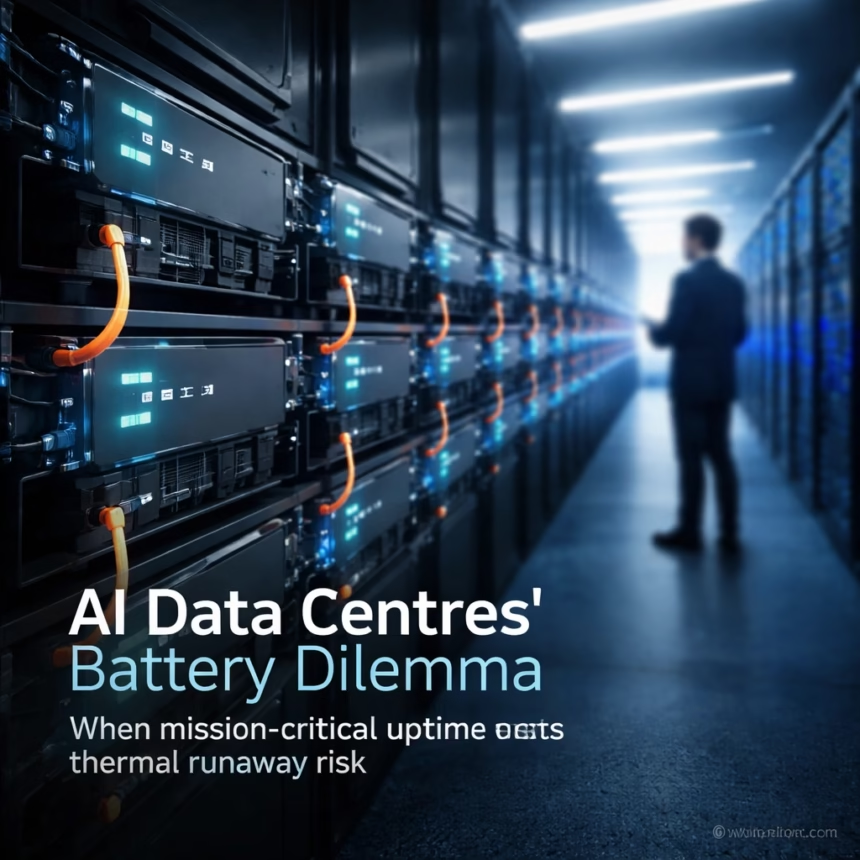
Global AI data centers are grappling with a critical paradox: the need for uninterrupted power to fuel advanced computing collides with the inherent thermal runaway risks of high-density battery storage. This escalating dilemma, unfolding across major tech hubs from Silicon Valley to Singapore, threatens not only operational uptime but also the safety of personnel and infrastructure as the demand for artificial intelligence surges.
Background: The Power Behind the AI Revolution
The explosive growth of artificial intelligence, particularly in large language models and generative AI, has triggered an unprecedented demand for computational power. This surge requires hyperscale data centers, which are essentially massive energy consumers, drawing megawatts and even gigawatts of electricity. To ensure continuous operation and prevent costly downtime from grid fluctuations or outages, these facilities rely heavily on Uninterruptible Power Supply (UPS) systems.
Historically, lead-acid batteries served as the primary energy storage for UPS systems. However, with the need for greater energy density, smaller footprints, and longer cycle life, lithium-ion (Li-ion) batteries rapidly became the preferred choice. Li-ion technology offers superior performance, allowing data centers to store more power in less space, a crucial advantage in land-constrained urban areas and for expanding existing facilities.
The inherent challenge with Li-ion batteries lies in their susceptibility to thermal runaway. This phenomenon occurs when an internal or external event, such as overcharging, physical damage, or extreme temperature, causes a battery cell to enter an uncontrolled self-heating state. The escalating heat can lead to a chain reaction, igniting adjacent cells, releasing toxic gases, and potentially resulting in fire or explosion. While individual Li-ion cells are common in consumer electronics, the sheer scale of battery banks required for a modern AI data center amplifies this risk significantly, transforming a localized incident into a potential catastrophe.

Key Developments: Mitigating the Mounting Risk
In recent years, the industry has seen a rapid evolution in both the scale of battery deployments and the strategies to manage their risks. Hyperscale AI data centers now deploy battery arrays capable of delivering tens of megawatts for critical minutes, far exceeding the capacity of traditional data center UPS systems. This necessitates more robust safety protocols and innovative technological solutions.
Emergence of Safer Chemistries
One significant development is the growing adoption of lithium iron phosphate (LFP) batteries. While LFP offers a slightly lower energy density compared to other Li-ion chemistries like NMC (nickel-manganese-cobalt), it boasts superior thermal stability, making it less prone to thermal runaway. Many data center operators are now prioritizing safety over maximum energy density for stationary applications, leading to increased LFP deployment in new builds and retrofits across North America, Europe, and Asia.
More Read

Advanced Management and Suppression Systems
Battery Management Systems (BMS) have become increasingly sophisticated. Modern BMS units not only monitor voltage, current, and temperature but also employ advanced algorithms to predict potential failures, balance cell charges, and isolate problematic modules. Alongside this, fire suppression technologies are evolving. Inert gas systems, aerosol generators, and specialized water mist systems are being deployed, often designed to target individual battery racks or modules rather than an entire data hall, containing incidents before they propagate.
Regulatory Scrutiny and Industry Standards
Regulatory bodies and industry associations are tightening guidelines. Standards such as NFPA 855 (Standard for the Installation of Stationary Energy Storage Systems) and UL 9540A (Test Method for Evaluating Thermal Runaway Fire Propagation in Battery Energy Storage Systems) provide critical frameworks for safe design, installation, and operation. These standards, continually updated, are influencing construction codes globally, pushing manufacturers and operators to adhere to stringent safety benchmarks.
Impact: The Broad Implications of the Battery Dilemma
The battery dilemma has far-reaching consequences across financial, operational, environmental, and safety domains for the AI data center industry.
Financial Burdens
Implementing advanced safety measures, including specialized fire suppression, enhanced cooling, and sophisticated BMS, significantly increases both the capital expenditure (CAPEX) and operational expenditure (OPEX) of data centers. Insurance premiums for facilities housing large Li-ion battery banks are also rising, reflecting the perceived risk. Furthermore, the financial impact of even a brief outage, let alone a fire, can be catastrophic, costing millions of dollars in lost revenue, data recovery, and reputational damage.
Operational Complexities
Designing and operating data centers with massive battery arrays introduces considerable operational complexity. Stringent maintenance schedules, specialized training for personnel, and sophisticated environmental controls are essential. The heat generated by large battery banks necessitates robust cooling infrastructure, adding to the overall energy consumption and design constraints of the facility. Space optimization becomes a delicate balance between maximizing computing power and ensuring adequate separation and access for safety systems.
Environmental and Safety Concerns
Beyond the immediate risk of fire, the materials used in Li-ion batteries pose environmental challenges during sourcing and end-of-life disposal. A thermal runaway event can release toxic gases, posing a direct threat to personnel and potentially impacting surrounding communities. The safe storage and disposal of damaged or expired battery cells also present a growing logistical and environmental hurdle for the industry.
More Read

What Next: Charting a Course for Sustainable Power
The future of AI data center power will likely involve a multi-faceted approach, combining technological innovation, regulatory evolution, and strategic energy planning.
Next-Generation Battery Technologies
Research and development continue apace for even safer and more efficient energy storage solutions. Solid-state batteries, which replace flammable liquid electrolytes with solid ones, promise significantly reduced fire risk and higher energy density, though commercial scalability remains a challenge. Flow batteries, another promising technology, offer inherent safety advantages as their energy storage and power conversion components are physically separated, making them less susceptible to thermal runaway.
Enhanced Grid Integration and Renewable Energy
To reduce reliance on massive on-site battery banks, data centers are exploring deeper integration with grid-scale energy storage solutions and direct connections to renewable energy sources. This could involve participating in demand response programs or co-locating near large solar and wind farms, potentially reducing the need for extensive UPS battery backup for extended outages. Microgrids and localized power generation, including small modular reactors (SMRs) for some hyperscale facilities, are also being considered as long-term solutions for stable, high-capacity power.
AI for AI’s Power
Ironically, AI itself is being leveraged to enhance battery safety. Predictive analytics, powered by machine learning, can analyze vast amounts of operational data from battery cells to detect subtle anomalies that might precede a thermal runaway event, enabling proactive maintenance or isolation. This “AI for AI” approach offers a new layer of intelligent safety management.
As the world races to harness the power of artificial intelligence, ensuring the reliable and safe operation of its foundational infrastructure remains paramount. The battery dilemma is not merely a technical challenge; it is a critical juncture demanding innovation, collaboration, and foresight to power the future responsibly.