Hormuz Annexed? Trump's AI Photo Claim Ignites Global Crisis
Hormuz Annexed? Trump's AI Photo Claim Ignites Global Crisis
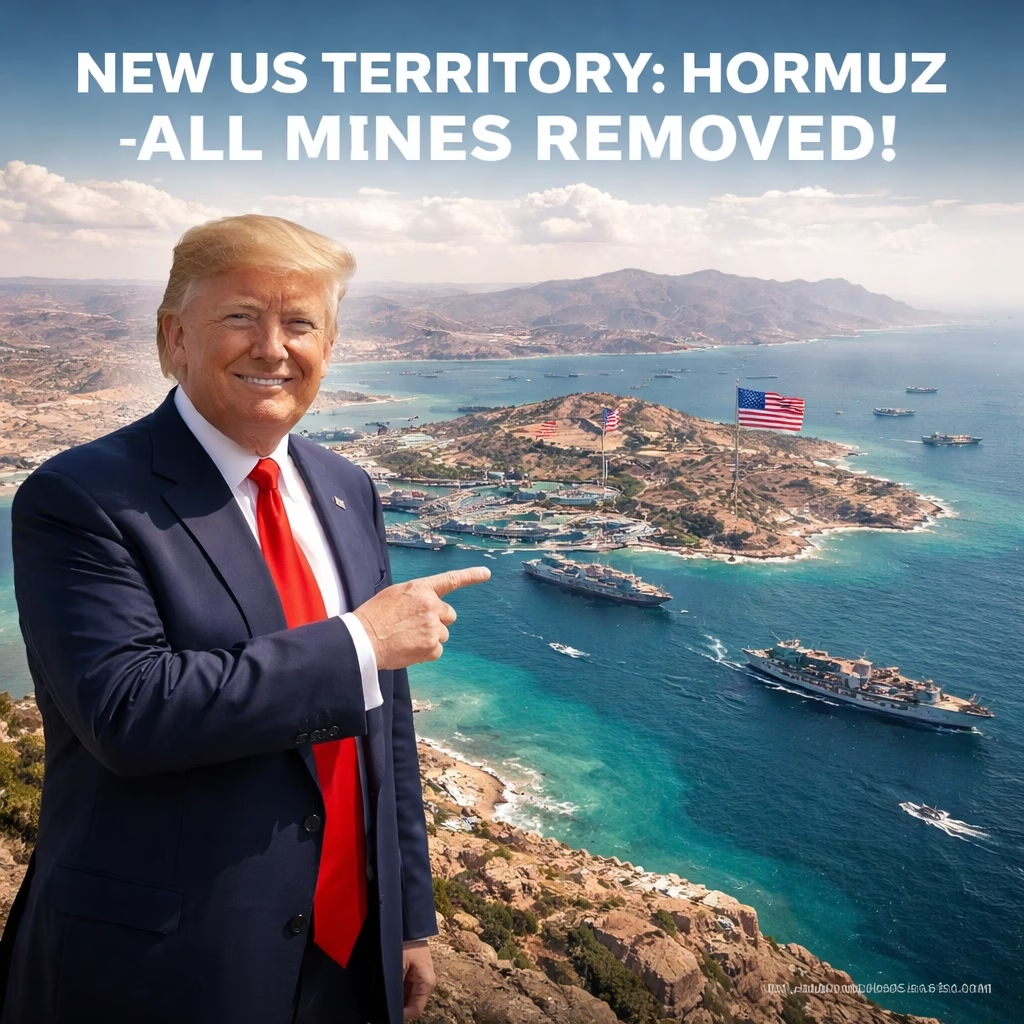
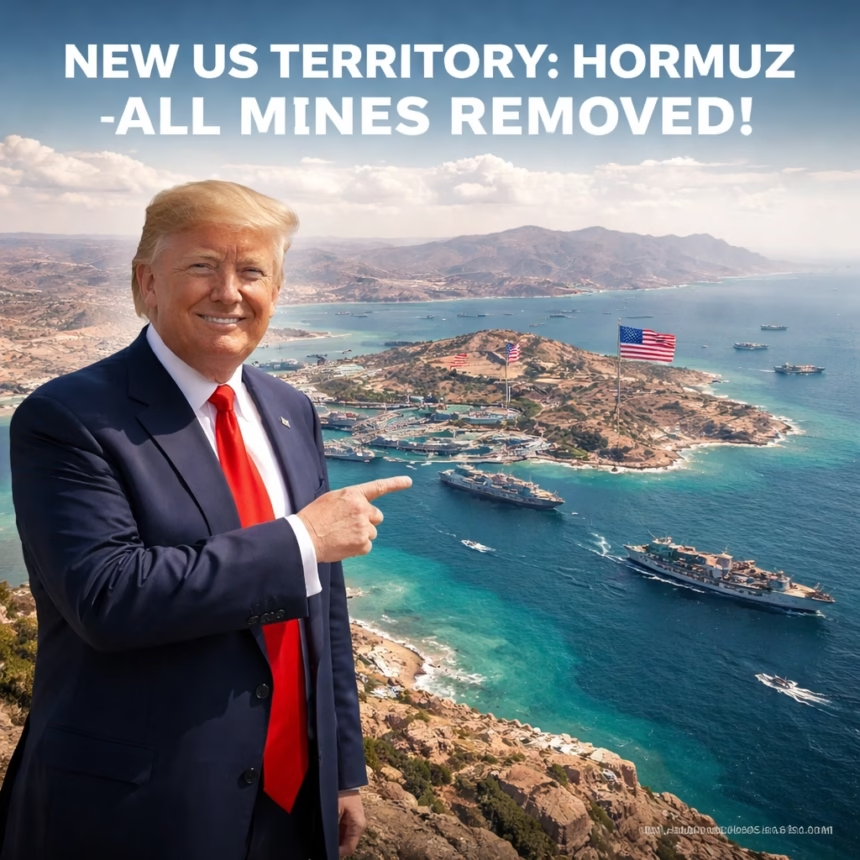
Former President Donald Trump sparked an international uproar on Friday, October 26, 2024, by posting an AI-generated image of the Strait of Hormuz on his social media platform, declaring the critical waterway "new US territory" and asserting that all mines had been removed. The unprecedented claim, made without official corroboration, immediately triggered alarm across diplomatic and financial sectors worldwide.
Background: A Chokepoint in Crisis
The Strait of Hormuz, a narrow passage connecting the Persian Gulf to the open ocean, is one of the world's most vital maritime chokepoints. Approximately one-fifth of the world's oil supply, along with significant volumes of liquefied natural gas, transits through its waters daily. Its strategic importance has historically made it a flashpoint for regional tensions, particularly between Iran, which borders the strait to the north, and various international naval forces, including the United States.
Incidents involving tanker seizures, alleged mine attacks, and naval confrontations have periodically escalated anxieties in the region for decades. The United States maintains a significant naval presence in the Persian Gulf, primarily through its Fifth Fleet, headquartered in Bahrain, to ensure freedom of navigation and regional stability.
More Read

Trump’s Past Rhetoric and AI’s Rise
Former President Trump's previous administration was characterized by an "America First" foreign policy, which often challenged established international norms and institutions. His withdrawal from the Iran nuclear deal (JCPOA) in 2018 and subsequent imposition of stringent sanctions significantly heightened tensions with Tehran. This past approach provides context for a unilateral declaration concerning a globally sensitive waterway.
The current political landscape is also increasingly shaped by the proliferation of artificial intelligence, particularly in visual media. AI-generated images, often highly realistic, have become a tool for both creative expression and, controversially, for disseminating unverified information or propaganda. The use of such an image in a high-stakes political declaration underscores growing concerns about information integrity and the blurring lines between reality and digital fabrication in public discourse.
No nation has ever unilaterally claimed an international strait of this magnitude as its sovereign territory, making Trump's declaration an unparalleled assertion in modern international relations.
More Read

Key Developments: The Post, The Reactions, The Reality
The controversial post appeared on "Truth Social" at approximately 10: 30 AM EST. The accompanying AI-generated image depicted a serene, almost idyllic Strait of Hormuz, with clear blue waters devoid of any visible maritime traffic or military presence, save for what appeared to be several small, stylized American flags digitally superimposed along the coastline. Trump's caption read: "MISSION ACCOMPLISHED! The Strait of Hormuz is now NEW US TERRITORY. All mines removed, thanks to our incredible patriots. Secured for America. BIGLY!"
Lack of Official Corroboration
Crucially, the Pentagon, the State Department, and the current White House administration offered no immediate confirmation of either the purported mine removal operation or any change in the Strait's international status. Defense officials, speaking anonymously due to the sensitivity of the matter, stated that they had no knowledge of any such operation or territorial claim. Similarly, State Department spokespersons refrained from commenting directly on the former president's post but reiterated the United States' commitment to international law and freedom of navigation.
Global Outcry and Skepticism
Reactions from global powers were swift and largely condemnatory. Iran's Foreign Ministry spokesperson, Nasser Kanaani, denounced the post as "a delusional and dangerous provocation," asserting that "the Strait of Hormuz is an an integral part of Iranian sovereignty and international waters, not a plaything for American political fantasies." He warned of "firm and decisive action" against any perceived infringement.
European allies, including the United Kingdom and France, expressed "grave concern" and called for immediate clarification from Washington. A spokesperson for the European Union emphasized the importance of the United Nations Convention on the Law of the Sea (UNCLOS) and the principle of freedom of navigation for all vessels. Regional partners like Saudi Arabia and the United Arab Emirates, while traditionally allied with the US, remained cautious, with official statements urging de-escalation and respect for international maritime law. Russia and China criticized the declaration as a dangerous act of unilateralism that threatened global stability.
AI Forensics Confirm Fabrication
Independent AI forensic analysts quickly confirmed the image's artificial origin. Dr. Anya Sharma, a leading expert in digital forensics at the University of Geneva, noted tell-tale signs such as inconsistent water patterns, unnaturally smooth coastlines, and repetitive cloud formations characteristic of generative AI models. "There are no signs of real-world naval activity or the complex environmental details one would expect in a genuine satellite or drone image of such a busy strait," Dr. Sharma explained. The claim of "all mines removed" also lacked any supporting evidence, raising questions about the operational feasibility and secrecy required for such an extensive, unannounced sweep.
Impact: Geopolitical Tremors and Market Volatility
The declaration immediately sent shockwaves through global commodity markets. Oil prices surged by over 7% within hours of the post, with Brent crude briefly topping $95 a barrel, fueled by fears of supply disruptions from the critical waterway. Shipping insurance premiums for vessels transiting the Persian Gulf region also saw a sharp increase, reflecting heightened perceived risks.
More Read

Challenge to International Law and Diplomacy
The broader implications for international law and diplomacy are profound. The unilateral assertion of sovereignty over an international strait directly challenges fundamental tenets of UNCLOS, which guarantees transit passage through such waterways. If left unchallenged, such a claim could set a dangerous precedent, potentially emboldening other nations to make similar assertions over strategically important passages, leading to a breakdown of established maritime legal frameworks.
For the current US administration, Trump's post created an immediate diplomatic crisis, forcing it to expend significant political capital to reassure allies and adversaries alike. It undermined existing diplomatic efforts to de-escalate tensions in the Middle East and complicated the administration's foreign policy agenda. Allies expressed frustration at being blindsided and having to navigate the fallout from a declaration made by a former president.
Regional Instability and Information Integrity
Regionally, the declaration significantly ratcheted up tensions between the United States and Iran. The potential for miscalculation or accidental escalation increased, with both sides potentially interpreting the other's actions as hostile. The stability of the entire Middle East hung precariously in the balance. Furthermore, the incident intensified concerns about the weaponization of AI in political discourse, further eroding trust in digital information and complicating efforts to combat misinformation on a global scale.
What Next: De-escalation and Diplomatic Maneuvers
The immediate priority for the current US administration is to issue a clear, unequivocal statement reaffirming the international status of the Strait of Hormuz and disavowing any territorial claims. Secretary of State Antony Blinken is expected to hold an emergency press conference Saturday morning, with anticipated calls to foreign ministers of key allies and regional partners. The Pentagon is also likely to issue a statement reiterating its commitment to freedom of navigation and potentially announcing increased surveillance in the region to monitor for any actual changes in maritime activity.
Diplomatic efforts are expected to intensify globally. The United Nations Security Council may convene an emergency session to address the perceived threat to international peace and security. Legal scholars are already debating the potential for an appeal to the International Court of Justice, though such processes are typically lengthy.
Iran is anticipated to respond with a show of force, likely in the form of naval exercises or increased patrols within its territorial waters and the Strait, to underscore its sovereignty and resolve. This could involve live-fire drills or the deployment of additional naval assets, further raising the stakes.
Former President Trump's next moves remain uncertain. He may double down on his claim, offering further unverified details, or he may allow the post to stand without further comment, leveraging the resulting controversy for political gain ahead of the upcoming election cycle. The incident will undoubtedly become a central talking point in the ongoing political debate, highlighting the increasing challenges posed by digital misinformation and the unique influence of former leaders in the age of social media. The world watches closely for how this unprecedented digital declaration will unfold in the realpolitik of international relations.