Explosive Triangle: Why the US, Israel, Iran Conflict Rocks Global Stability – Your SA Guide
Explosive Triangle: Why the US, Israel, Iran Conflict Rocks Global Stability – Your SA Guide
"The Lead," a new podcast series, offers South African listeners a comprehensive guide to the complex and evolving dynamics between the United States, Israel, and Iran. Launched this month, the series aims to demystify the historical grievances, strategic interests, and recent escalations shaping the Middle East. It specifically targets an SA audience, providing context relevant to their geopolitical understanding and highlighting the conflict's far-reaching implications.
Background: A Century of Shifting Alliances and Deepening Rifts
The current tensions between the United States, Israel, and Iran are rooted in decades of complex historical events, ideological shifts, and strategic realignments. Understanding this intricate web requires examining each bilateral relationship and their intersections.

The US-Iran Rift: From Ally to Adversary
The relationship between Washington and Tehran dramatically shifted after Iran’s 1979 Islamic Revolution. Prior to this, the US had been a key supporter of the Shah’s regime, even orchestrating a 1953 coup that restored him to power. The revolution, fueled by anti-Western sentiment, led to the 444-day hostage crisis at the US embassy, severing diplomatic ties that remain broken today. Subsequent decades saw a US policy focused on containing Iran, particularly after its nuclear ambitions became clear in the early 2000s. This culminated in international sanctions and the 2015 Joint Comprehensive Plan of Action (JCPOA), a multilateral agreement designed to curb Iran’s nuclear program in exchange for sanctions relief.
Israel and Iran: From Covert Allies to Existential Foes
Paradoxically, pre-1979 Iran and Israel maintained a discreet, pragmatic relationship, sharing concerns over Arab nationalism. The Islamic Revolution fundamentally altered this dynamic. Iran’s new government adopted an anti-Zionist stance, viewing Israel as an illegitimate occupier of Palestinian lands and a regional extension of US influence. Tehran began actively supporting groups like Hezbollah in Lebanon and Hamas in Palestine, positioning itself as a leader of the “Axis of Resistance.” Israel, in turn, views Iran’s nuclear program, its ballistic missile capabilities, and its regional proxy network as an existential threat, vowing to prevent Iran from acquiring nuclear weapons at all costs.
The US-Israel Alliance: A Cornerstone of Middle East Policy
The strategic alliance between the United States and Israel has been a constant in the region for over half a century. Rooted in shared democratic values, security interests, and significant US financial and military aid, this partnership often aligns Washington and Jerusalem against common adversaries. The US has consistently supported Israel’s security, providing advanced weaponry and diplomatic backing, particularly at the United Nations. This strong bond often means that US policy towards Iran is heavily influenced by Israeli security concerns, creating a united front against Tehran’s regional ambitions and nuclear program.
More Read

Key Developments: Escalation in a Volatile Region
Recent years have witnessed a significant acceleration of tensions, bringing the US, Israel, and Iran closer to direct confrontation than ever before. These developments span nuclear proliferation, proxy conflicts, and direct military engagements.
The Unraveling of the Nuclear Deal
A pivotal moment came in May 2018 when the Trump administration unilaterally withdrew the US from the JCPOA, reimposing stringent sanctions on Iran. This move, heavily advocated by Israel, prompted Iran to gradually scale back its commitments under the deal, increasing uranium enrichment levels, installing advanced centrifuges, and limiting international inspections. By 2024, Iran’s nuclear program had progressed to a point where it possessed enough highly enriched uranium for multiple nuclear weapons, significantly reducing its “breakout time” – the period needed to produce weapons-grade material.
Shadow Wars and Direct Confrontations
The withdrawal from the JCPOA intensified a long-running “shadow war” between Israel and Iran. Israel has conducted numerous airstrikes in Syria, targeting Iranian assets and shipments of advanced weaponry to Hezbollah. It has also been implicated in cyberattacks and assassinations of Iranian nuclear scientists. The US also engaged directly. In January 2020, a US drone strike in Baghdad assassinated Major General Qassem Soleimani, commander of the IRGC Quds Force, a significant escalation that saw Iran retaliate with missile strikes on US military bases in Iraq, causing traumatic brain injuries to US personnel.
Regional Realignment: The Abraham Accords
In 2020, the US brokered the Abraham Accords, normalizing relations between Israel and several Arab nations, including the United Arab Emirates, Bahrain, Sudan, and Morocco. While presented as a step towards regional peace, a primary strategic objective was to forge a united front against Iran, integrating Israel more deeply into regional security architecture and isolating Tehran.
The Gaza War and Wider Regional Flare-ups
The October 7, 2023, attacks by Hamas on Israel and the subsequent Israeli military response in Gaza dramatically escalated regional tensions. Iran, a key backer of Hamas and other groups within its “Axis of Resistance,” saw its proxies activate. Hezbollah in Lebanon engaged in daily cross-border skirmishes with Israel. Houthi rebels in Yemen, also supported by Iran, launched missile and drone attacks on international shipping in the Red Sea, prompting US and UK retaliatory strikes. In April 2024, following an Israeli strike on an Iranian consulate building in Damascus, Iran launched an unprecedented direct missile and drone attack on Israel, which was largely intercepted. Israel responded with a limited strike inside Iran, signaling a dangerous new phase of direct, albeit contained, exchanges.
Impact: Global Ripples from a Regional Powder Keg
The US, Israel, Iran conflict extends far beyond the Middle East, generating significant global ramifications across economic, geopolitical, and humanitarian spheres. South Africa, though geographically distant, is not immune to these effects.
More Read

Global Economic Instability
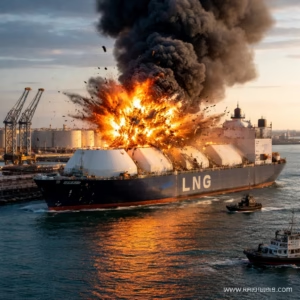
One of the most immediate impacts is on global energy markets. The Strait of Hormuz, a critical chokepoint for a fifth of the world’s oil supply, is directly threatened by any escalation involving Iran. Disruptions or threats to shipping routes, as seen with Houthi attacks in the Red Sea, drive up oil prices and insurance costs, affecting consumers and industries worldwide. South Africa, a net importer of oil, directly feels these price hikes at the fuel pump, impacting inflation and economic stability.
Heightened Geopolitical Tensions
The conflict exacerbates global geopolitical divisions. It strains relations between major powers, particularly the US and its allies against Russia and China, who often adopt more conciliatory stances towards Iran. The stalled efforts to revive the JCPOA highlight the paralysis of international diplomacy. The proliferation risk posed by Iran’s nuclear advancements also poses a direct challenge to the global non-proliferation regime, potentially encouraging other nations to pursue nuclear weapons.
Humanitarian Crises and Regional Instability
The proxy conflicts fueled by the US-Israel-Iran rivalry contribute to devastating humanitarian crises in countries like Syria, Yemen, and now Gaza. Millions have been displaced, and civilian populations bear the brunt of prolonged conflict, food insecurity, and destroyed infrastructure. The risk of a wider regional conflagration remains high, threatening to destabilize neighboring states and generate new waves of refugees.
Implications for South Africa
For South Africa, the conflict presents several challenges. Economically, beyond fuel prices, disruptions to global trade routes can affect supply chains and export markets. Diplomatically, South Africa’s non-aligned foreign policy, its historical solidarity with Palestine, and its membership in BRICS (Brazil, Russia, India, China, South Africa) place it in a complex position. While advocating for multilateralism and peaceful resolution, it must navigate its relationships with both Western powers and states like Iran, which is also a BRICS member. The conflict also tests the global order and international law, principles South Africa often champions.
What Next: Navigating an Uncertain Future
The trajectory of the US, Israel, Iran conflict remains highly unpredictable, with several critical junctures and potential scenarios on the horizon.
The Nuclear Dilemma
Iran’s continued advancement of its nuclear program will be a central concern. The international community faces a critical choice: either pursue renewed, more robust diplomatic efforts to constrain Iran’s capabilities or risk a military confrontation. The effectiveness of the IAEA’s monitoring will be crucial, as will the political will of all parties to engage in meaningful negotiations, potentially after the US presidential elections in November 2024.
Risk of Regional Expansion
The most immediate danger is a further escalation of regional conflicts. The ongoing hostilities between Israel and Hezbollah, the Houthi attacks in the Red Sea, and the presence of Iranian-backed militias in Iraq and Syria all carry the potential for miscalculation and wider war. A direct, sustained conflict between Israel and Iran, or involving the US, would have catastrophic consequences for the entire Middle East and beyond. De-escalation efforts, possibly through third-party mediation or back-channel diplomacy, will be vital.
The US Political Landscape
The upcoming US presidential election in November 2024 could significantly alter US policy towards Iran and Israel. A change in administration might bring a renewed push for diplomacy with Iran, a different approach to the Abraham Accords, or a continuation of the current “maximum pressure” strategy. Each outcome carries distinct implications for regional stability.
South Africa’s Role and BRICS Influence
South Africa, as a prominent voice for the Global South and a member of an expanded BRICS bloc that now includes Iran, could play an increasingly important diplomatic role. Its advocacy for international law, human rights, and peaceful resolution, coupled with its non-aligned stance, positions it uniquely to contribute to de-escalation efforts or facilitate dialogue. The BRICS platform itself could become a forum for discussing regional security, offering alternative perspectives to traditional Western-led initiatives. However, balancing these roles while upholding its own national interests will be a delicate act.
The "Lead" podcast aims to equip South Africans with the nuanced understanding needed to interpret these complex developments and their profound implications for global peace and security.