NASA announced early October 2024 the official cessation of efforts to mount a rescue mission for the aging Aethelred Space Telescope. The decision marks the end of a multi-year feasibility study aimed at extending the operational life of the venerable observatory, currently adrift in deep space at the Sun-Earth L2 point. This development signals a definitive conclusion to the telescope's groundbreaking scientific contributions, leaving the astronomical community to reconcile with the imminent loss of a vital observational platform.
Background: A Legacy of Discovery and Decline
The Aethelred Space Telescope, named after the pioneering astrophysicist Dr. Elara Aethelred, was launched aboard an Atlas V rocket on September 12, 2005. Designed for a projected 10-year mission, Aethelred quickly surpassed expectations, operating for nearly two decades. Positioned approximately 1.5 million kilometers from Earth at the second Lagrange point (L2), its vantage point offered unparalleled views of the cosmos, free from Earth's atmospheric interference.
Aethelred's primary mission objectives included detailed observations of exoplanet atmospheres, mapping the distribution of dark matter in the early universe, and studying the formation of the first galaxies. Among its most celebrated achievements was the first direct spectroscopic analysis of a 'super-Earth' exoplanet's atmosphere, revealing the presence of water vapor. It also provided crucial data that refined our understanding of the universe's expansion rate and offered stunning deep-field images that pushed the boundaries of cosmic visibility.
However, by late 2020, the telescope began exhibiting critical signs of aging. The most significant issues included a gradual degradation of its cryogenic cooling system, essential for its sensitive infrared instruments, and intermittent failures in its reaction wheels, which maintain the telescope's precise pointing stability. Power output from its solar arrays also showed a measurable decline, signaling the eventual end of its operational life.
The idea of a servicing mission first emerged in early 2021, spurred by the scientific community's desire to extend Aethelred's unique capabilities. Initial discussions within NASA explored various concepts, ranging from robotic refueling and component replacement to more complex in-situ repairs. In February 2022, the agency formally initiated the "Aethelred Servicing Study Group," tasking engineers and scientists with assessing the technical and financial viability of such an undertaking.
More Read

Key Developments: The Unsurmountable Hurdles
The Aethelred Servicing Study Group concluded its extensive review in September 2024, presenting its findings to NASA Administrator Dr. Evelyn Reed and the agency's Science Mission Directorate. The report highlighted several insurmountable obstacles that ultimately led to the decision against a rescue mission.
Technical Complexities
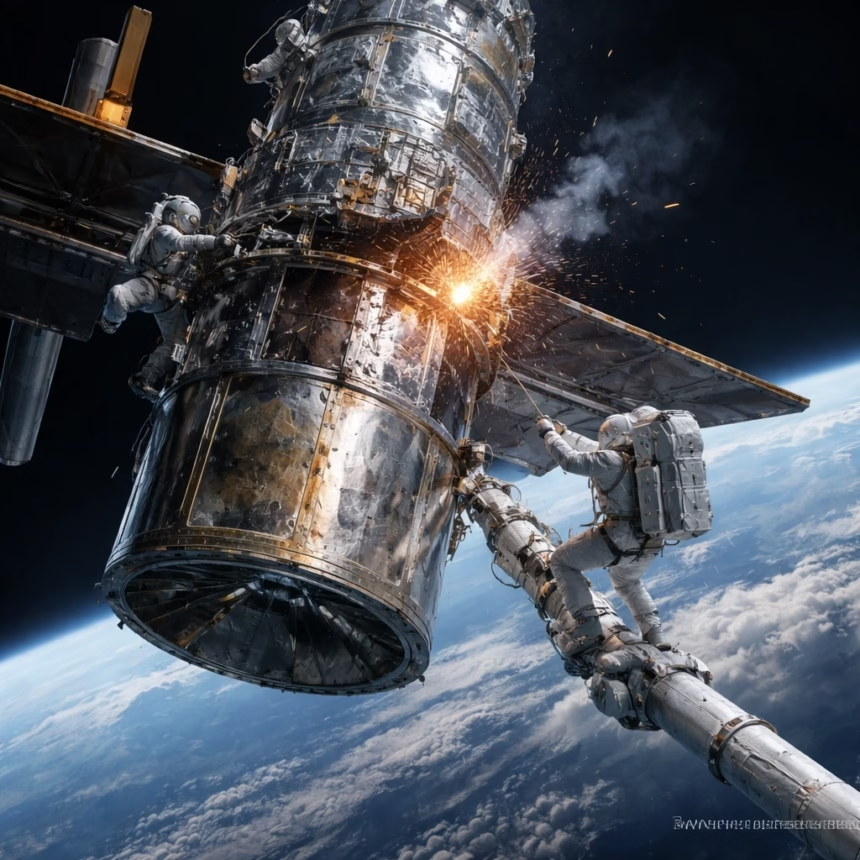
A primary challenge was Aethelred's original design. Unlike the Hubble Space Telescope, which was specifically engineered for astronaut servicing in low Earth orbit, Aethelred was not built with in-orbit repair in mind. It lacked crucial features such as standardized grapple fixtures for robotic attachment, easily accessible service ports for component replacement, and robust internal diagnostic systems compatible with remote intervention. Any attempt at servicing would require highly specialized, custom-built robotic tools and procedures, significantly increasing both risk and cost.
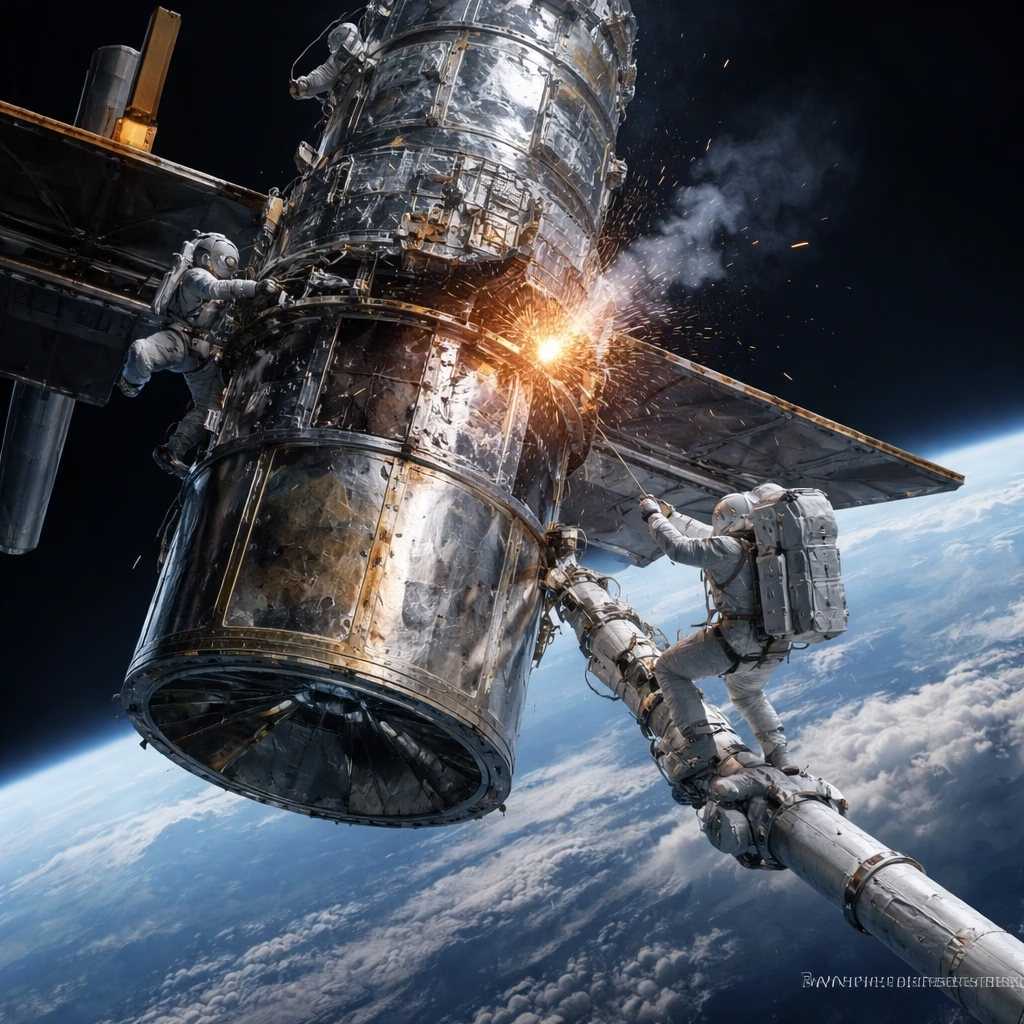

The telescope's distant L2 orbit, 1.5 million kilometers from Earth, presented another formidable technical hurdle. This distance meant communication delays of several seconds, making real-time teleoperation of a robotic arm extremely difficult and prone to errors. Furthermore, the journey to L2 for a servicing vehicle would be lengthy, requiring advanced propulsion systems and precise navigation, adding layers of complexity and potential points of failure.
Prohibitive Costs and Risks
The financial projections for a successful robotic servicing mission escalated dramatically throughout the study. Initial estimates of a few billion dollars quickly ballooned, with the final assessment placing the cost between $8 billion and $10 billion over a decade for development, launch, and execution. This figure included the design and construction of a dedicated servicing spacecraft, specialized robotic manipulators, and extensive ground support infrastructure.
NASA Administrator Dr. Evelyn Reed, in her official statement, emphasized that such an investment would divert critical resources from future missions and ongoing scientific endeavors. "While the scientific return from an extended Aethelred mission would be invaluable, the estimated costs and the inherent risks associated with a mission of this unprecedented complexity were simply too high to justify, especially given the current fiscal climate and our commitment to a balanced portfolio of missions," Dr. Reed stated.
The risk assessment also played a crucial role. Engineers determined there was a high probability of mission failure, ranging from an inability to dock or grapple the telescope to accidental damage during repair attempts. The "no-fault-tolerant" design of Aethelred meant that a single error could render the entire observatory permanently inoperable, wasting billions of dollars and years of effort.
Impact: A Void in Cosmic Observation
The decision to forgo a rescue mission has significant implications for the global scientific community and the public. Astronomers, cosmologists, and exoplanet researchers who relied on Aethelred's unique capabilities now face a substantial void in their observational toolkit.
The loss of Aethelred's high-resolution infrared imaging capabilities will particularly impact exoplanet characterization, delaying progress in identifying potentially habitable worlds and understanding their atmospheric compositions. Deep-field surveys and studies of the early universe will also be affected, as Aethelred provided complementary data to other observatories, often filling gaps in wavelength coverage and spatial resolution.
More Read

Beyond the scientific community, the public, often captivated by Aethelred's stunning images and groundbreaking discoveries, may feel a sense of loss. The telescope became an icon, inspiring generations with its glimpses into the universe's deepest secrets. Its eventual silence serves as a poignant reminder of the finite lifespan of even the most advanced human endeavors in space.
For NASA, the decision underscores the challenges of long-duration space missions and may influence future telescope designs. There is an increasing emphasis on modularity, in-orbit serviceability, and longer design lifespans from the outset for future large-scale observatories, learning from Aethelred's predicament.
What Next: Final Observations and Future Horizons
With the rescue mission officially off the table, NASA's focus now shifts to maximizing the remaining operational life of the Aethelred Space Telescope. Engineers are working to download any remaining critical data, calibrate instruments for final observations, and prepare for its eventual decommissioning.
Aethelred is expected to continue passive observation until its systems fully degrade, a process estimated to take another 12 to 18 months. Due to its L2 orbit, no active de-orbiting maneuver is planned; the telescope will gradually drift into a stable, long-term graveyard orbit around the Sun-Earth L2 point, becoming a silent sentinel in deep space.
The agency is now accelerating plans for successor missions. The proposed "Genesis Space Telescope," slated for launch in the early 2030s, is envisioned to pick up many of Aethelred's scientific objectives, with enhanced capabilities in infrared spectroscopy and direct exoplanet imaging. Additionally, projects like the "ExoSurveyor" mission are being prioritized to fill the immediate observational gaps in exoplanet characterization.
The comprehensive report from the Aethelred Servicing Study Group will be made public in late 2024. It is expected to serve as a crucial case study for future large-scale space observatories, informing design choices for repairability, longevity, and the economic realities of extending mission lifespans in challenging orbital environments. While the stars may dim for Aethelred, its legacy will undoubtedly continue to guide humanity's gaze toward the cosmos for decades to come.