Hormuz Holdout: Iran's Military Predicts Economic Jackpot from Strategic Strait
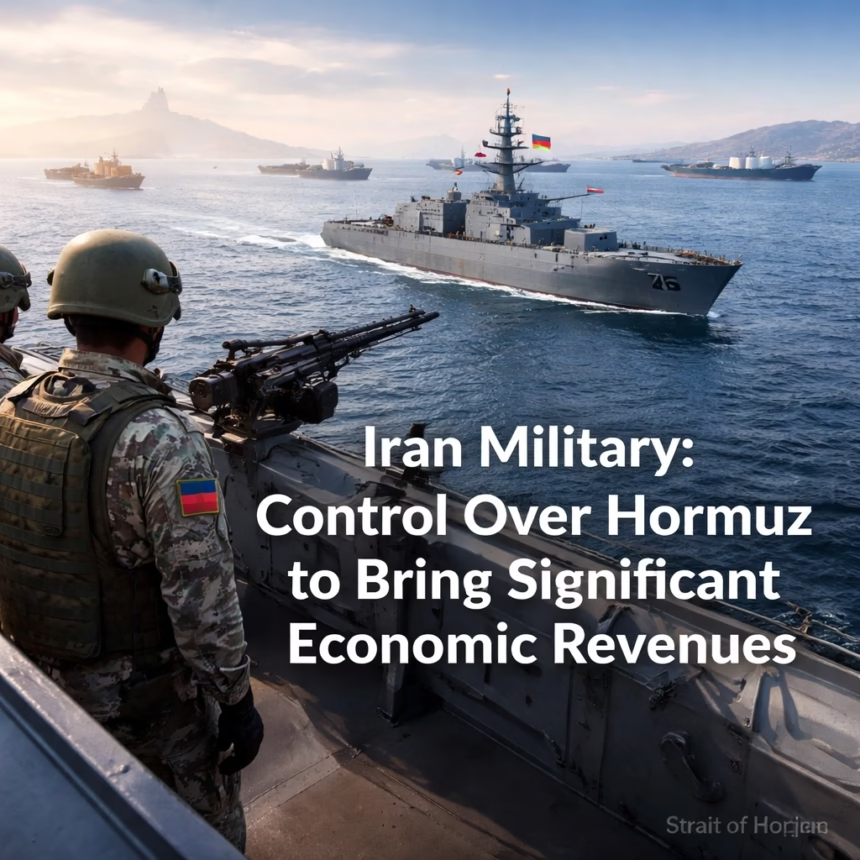
Iranian military officials have recently asserted that their nation's full control over the Strait of Hormuz, the critical global oil chokepoint, would generate substantial economic revenues for Tehran. This declaration, made amidst ongoing regional tensions in the Persian Gulf, signals a potential shift in Iran's strategic calculus regarding one of the world's most vital maritime passages.
The pronouncement comes at a time when global energy markets remain sensitive to geopolitical shifts, raising questions about international shipping lanes and the principles of freedom of navigation. Tehran's military leadership frames this potential control not merely as a defensive measure but as a direct pathway to significant national income, challenging established international norms governing maritime transit.
Background: A Chokepoint of Global Significance
The Strait of Hormuz, a narrow waterway connecting the Persian Gulf to the Arabian Sea, is the world’s most important oil transit chokepoint. Approximately one-fifth of global petroleum consumption and one-third of global liquefied natural gas (LNG) transits this 21-mile-wide passage annually. Bordered by Iran to the north and Oman and the UAE to the south, its strategic importance profoundly influences global energy prices and supply security.
For decades, Iran has leveraged its geographical position, periodically threatening to close the strait in response to international sanctions or perceived military threats. These threats were largely viewed as a deterrent to exert pressure. Under international maritime law, specifically the United Nations Convention on the Law of the Sea (UNCLOS), Hormuz is an international strait guaranteeing transit passage for all vessels, a right safeguarded by forces like the US Navy’s Fifth Fleet, based in Bahrain.
The strait has been a flashpoint for numerous incidents. In 2019, Iran seized the British-flagged oil tanker Stena Impero. More recently, in 2023, the Islamic Revolutionary Guard Corps Navy (IRGC Navy) seized the Marshall Islands-flagged Advantage Sweet, asserting it was in response to a US seizure of Iranian oil. Iran’s naval capabilities, particularly the IRGC Navy’s asymmetric warfare doctrine utilizing fast attack craft and anti-ship missiles, pose a significant threat to commercial shipping in these confined waters.

Key Developments: From Deterrence to Economic Exploitation
Recent pronouncements from Tehran mark a significant conceptual shift: from viewing Hormuz as a strategic leverage point for deterrence to a source of direct economic benefit. Senior military figures, including commanders within the Islamic Revolutionary Guard Corps (IRGC), have explicitly linked control over the waterway to substantial national income.
While specific implementation details remain vague, the underlying message suggests imposing transit fees, security levies, or other tariffs on vessels. One high-ranking IRGC Navy commander reportedly stated that if Iran were to fully assert its sovereignty, the “natural economic rights” associated with managing such a crucial passage would inherently accrue to the nation. This implies a belief that Iran is currently foregoing significant potential revenue.
This evolving rhetoric coincides with ongoing Iranian naval exercises in the Persian Gulf, showcasing their operational presence and readiness. These drills, involving missile boats, drones, and submarines, aim to project power and demonstrate capacity to monitor and interdict maritime traffic. The timing suggests a deliberate strategy to couple military posturing with a new economic rationale for asserting control.
More Read

This shift could be interpreted as Iran seeking new income avenues amidst persistent international sanctions that have severely hampered its oil exports and broader economy. By framing Hormuz control as an economic opportunity, Tehran might be attempting to garner domestic support or create a new bargaining chip in future international negotiations.
Impact: Global Repercussions and Regional Anxiety
Any unilateral assertion of economic control over the Strait of Hormuz by Iran would trigger profound global repercussions. Immediately, global oil and gas prices would likely spike, driven by market uncertainty and supply disruption fears. The shipping industry would face severe challenges, with insurance premiums for Gulf transit skyrocketing and potential re-routing adding significant costs and delays to global trade.
Regionally, major oil and gas exporters like Saudi Arabia, the UAE, Qatar, Kuwait, and Iraq, who rely almost exclusively on Hormuz for exports, would see direct impacts on their national revenues and stability. Similarly, major energy importers—China, India, Japan, South Korea, and various European countries—would face severe threats to their energy security and economic growth.
For the United States and its allies, such a move would directly challenge the fundamental principle of freedom of navigation, necessitating a robust response. This could involve increased naval deployments, stronger diplomatic condemnations, and the exploration of new sanction regimes, significantly elevating the risk of military confrontation and broader regional instability.
While Iran envisions potential economic gains, the international backlash would likely lead to further economic isolation and a collective effort by global powers to circumvent or neutralize such unilateral control. The severe costs of international condemnation and potential military conflict would likely overshadow any perceived long-term economic benefits for Iran.
More Read

What Next: Navigating a Volatile Future
Iran’s military assertions set the stage for a complex and potentially volatile period. The immediate future will likely see strong international condemnations from the US, EU, and regional allies, reiterating commitment to freedom of navigation. The UN and international maritime organizations will be called upon to address Iran’s claims, emphasizing adherence to UNCLOS.
Diplomatic efforts will focus on de-escalation, urging Iran to retract or clarify its intentions. However, given current geopolitical tensions, significant diplomatic breakthroughs may be challenging. Militarily, increased naval deployments and exercises by both Iran and international forces, particularly the US Navy’s Fifth Fleet, are probable to demonstrate resolve and maintain open shipping lanes.
Economically, any Iranian attempt to implement transit fees could trigger targeted sanctions. Major energy consumers might accelerate efforts to diversify sources or invest in alternative, albeit costly, transport routes bypassing the strait. This includes expanded pipeline networks, though these are long-term solutions.
The core question remains whether these pronouncements are a genuine policy shift, a rhetorical tactic for leverage, or a warning amidst domestic pressures. Any concrete move by Iran to enforce economic control over the strait would be widely viewed as an act of aggression, risking severe international response and potential military confrontation. The global reliance on Gulf energy exports means any escalation regarding Hormuz carries immense risks for regional stability and the global economy.