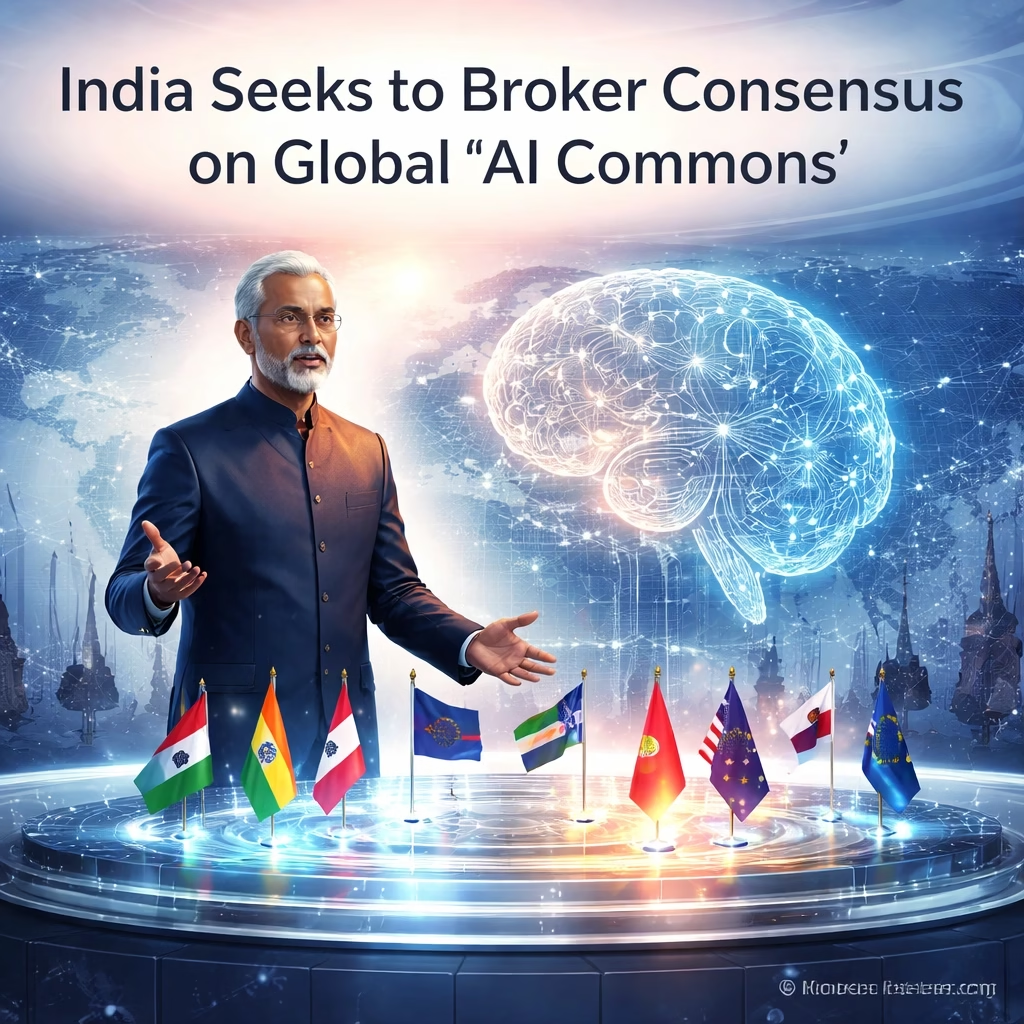
India seeks to broker consensus on global ‘AI commons’

Viral_X
By
Viral_X
6 Min Read
#image_title

New Delhi, India – In a move signaling growing global concern and collaborative effort, India has taken the lead in attempting to forge a consensus on a global "AI commons," aiming to establish shared principles and standards for the development and deployment of artificial intelligence. The initiative, officially announced on February 1, 2024, at the G20 Digital Economy and Innovation Ministerial Meeting in New Delhi, seeks to address the ethical, societal, and economic implications of rapidly advancing AI technologies.

Background: A Growing Need for Global Governance

The concept of an "AI commons" isn't entirely new. Discussions around responsible AI have been ongoing for several years, spurred by increasing AI capabilities and their potential impact. Initial explorations occurred during the 2021 G7 Digital Economy and Innovation Ministerial Meeting in Hiroshima, Japan, where the nations discussed the need for international cooperation in AI governance. However, progress has been slow due to diverging national interests and differing views on the role of regulation. Several organizations, including the OECD and UNESCO, have been developing AI frameworks and guidelines, highlighting a global recognition of the need for a coordinated approach. The EU's AI Act, proposed in March 2023, represents a significant step towards comprehensive AI regulation within Europe.

India seeks to broker consensus on global ‘AI commons’

Key Developments: India’s Proactive Role

India's initiative is noteworthy for its proactive approach. External Minister Subrahmanyam Jaishankar emphasized the importance of a multilateral framework that balances innovation with responsible development. He stressed the need for a "shared understanding" among nations to navigate the complexities of AI. The discussions in New Delhi focused on several key areas, including:

* Ethical Principles: Emphasis was placed on establishing ethical guidelines for AI development, covering areas like fairness, transparency, accountability, and human rights.
* Data Governance: The importance of secure and responsible data management for AI training and deployment was highlighted, particularly concerning data privacy and security.
* International Cooperation: India advocated for establishing a platform for ongoing dialogue and collaboration among nations to address emerging AI challenges.
* Open Source AI: Promoting open-source AI technologies was suggested as a way to foster innovation and ensure accessibility.
* AI Safety: Discussion included establishing frameworks to proactively mitigate potential risks associated with advanced AI systems.

The talks involved representatives from various G20 nations, including the United States, China, the European Union, and Japan. Several countries expressed willingness to engage in further discussions, albeit with reservations regarding the scope and authority of a potential "AI commons."

Impact: Shaping the Future of AI and Its Applications

The implications of a successful "AI commons" are far-reaching. It could influence:

* AI Development: The framework would shape the direction of AI research and development, encouraging responsible innovation.
* AI Deployment: It would influence how AI technologies are deployed in various sectors, including healthcare, finance, and transportation.
* Economic Growth: By fostering trust and confidence in AI, the initiative could accelerate economic growth and create new opportunities.
* Social Impact: It could help mitigate potential negative social consequences of AI, such as job displacement and algorithmic bias.
* Geopolitical Landscape: The effort could shift the balance of power in the AI space, potentially strengthening India's role as a leading innovator and advocate for responsible AI governance.

The initiative is particularly relevant for developing nations like India, which stand to benefit greatly from the advancements in AI but also face unique challenges in ensuring equitable access and mitigating potential risks.

What Next: Towards a Collaborative Framework

The immediate next steps involve further consultations among G20 members to refine the proposed framework and address remaining disagreements. The Indian government is likely to continue advocating for a multilateral approach and emphasizing the importance of inclusive participation.

* Further Consultations: The G20 is expected to hold follow-up meetings in the coming months to discuss the technical details of the proposed framework.
* Stakeholder Engagement: India plans to engage with a broader range of stakeholders, including industry experts, academics, and civil society organizations, to gather input and build consensus.
* Pilot Projects: To demonstrate the practical benefits of an "AI commons," India may initiate pilot projects in specific sectors.
* International Organizations: Engagement with organizations like the UN and UNESCO will be crucial to ensure global alignment and support.

The establishment of a global "AI commons" is a complex undertaking, but India's initiative represents a significant step towards fostering a more responsible and collaborative approach to the development and deployment of artificial intelligence. Success will depend on the willingness of nations to prioritize shared values and work together to address the challenges and opportunities presented by this transformative technology.


Share This Article

India seeks to broker consensus on global ‘AI commons’

Viral_X
By
Viral_X
10 Min Read
#image_title

India is spearheading an ambitious diplomatic initiative to establish a global "AI commons," aiming to foster open, safe, and responsible artificial intelligence development worldwide. This significant push, leveraging its recent G20 presidency and burgeoning digital expertise, seeks to build international consensus on shared AI resources and ethical governance frameworks. The endeavor represents a strategic effort to democratize access to advanced AI capabilities and prevent the concentration of power in a few hands.

Background: India’s Vision for Shared Digital Futures

The concept of an "AI commons" draws heavily from the principles of open-source collaboration and shared digital public infrastructure, a model India has successfully pioneered domestically. An AI commons envisions a global repository of open-source AI models, datasets, computing power, and ethical guidelines, accessible to all nations and developers. This shared ecosystem aims to accelerate innovation while ensuring equitable access and mitigating inherent risks like bias and misuse.


India's leadership in this domain gained significant momentum during its G20 presidency in 2023. The G20 Leaders' Declaration, issued in New Delhi in September 2023, explicitly acknowledged the need for responsible AI development and governance. Union Minister of State for Electronics and Information Technology, Rajeev Chandrasekhar, has been a vocal proponent, advocating for a global framework that mirrors India's success with its Digital Public Infrastructure (DPI). India's DPI, which includes systems like the Unified Payments Interface (UPI) for financial transactions and Aadhaar for digital identity, has demonstrated how open, interoperable platforms can drive economic inclusion and innovation at scale.

The global context for this initiative is marked by growing concerns over AI's rapid advancement. Debates around AI safety, ethical implications, the potential for job displacement, and the geopolitical implications of AI dominance have intensified. Many nations, particularly those in the Global South, fear being left behind or becoming solely consumers of AI technologies developed elsewhere. India positions its AI commons proposal as a solution to bridge this technological divide and ensure that AI benefits all of humanity, not just a select few.

India seeks to broker consensus on global ‘AI commons’

The Digital Public Infrastructure Model

India's DPI model serves as a foundational blueprint for the proposed AI commons. These digital platforms are built on open standards, open APIs, and open-source software, allowing diverse innovators to build applications and services on top of them. This approach has fostered a vibrant ecosystem of startups and businesses, driving digital transformation across various sectors. By advocating for an AI commons, India aims to replicate this success globally, creating a collaborative environment for AI innovation that prioritates public good over proprietary interests. This model emphasizes the creation of foundational capabilities that are shared, allowing for specialized applications to be built by anyone, anywhere.

Key Developments: Forging Consensus and Open-Source Imperatives

India's diplomatic efforts have involved extensive bilateral and multilateral engagements to build support for the AI commons. Discussions have spanned various international forums, including the United Nations, the World Economic Forum, and direct dialogues with countries like the United States, the United Kingdom, and members of the European Union. A central tenet of these discussions is the promotion of open-source AI models and datasets, which India believes are crucial for fostering transparency, explainability, and widespread innovation.

The Indian government has emphasized the need for a "Global DPI for AI," a framework that would facilitate the sharing of foundational AI models and resources. This would involve international collaboration on training robust, unbiased models, establishing common benchmarks for safety and performance, and developing shared ethical guidelines. India's argument is that proprietary, closed-source AI systems, while powerful, can exacerbate existing inequalities and make independent auditing and scrutiny difficult. An open-source approach, conversely, allows for collective improvement, bug fixes, and the identification of biases by a global community of developers and researchers.

Recent high-level meetings have seen India garnering initial support for its vision. While the specifics of implementation remain under discussion, there is a growing recognition among several nations of the need for a more inclusive and responsible approach to AI governance. India has also highlighted the importance of developing AI solutions tailored to the unique challenges faced by developing countries, from improving agricultural yields to enhancing public health systems. This focus on "AI for good" and addressing the needs of the Global South is a distinguishing feature of India's proposal.

Bridging the AI Divide

A significant aspect of India's initiative is its focus on preventing a widening "AI divide" between technologically advanced nations and the rest of the world. By advocating for shared resources, India aims to empower countries with limited technological infrastructure or financial resources to participate meaningfully in the AI revolution. This not only promotes fairness but also ensures that AI solutions are diverse, reflecting a broader range of cultural contexts and societal needs, rather than being dominated by a few perspectives. The open-source nature of the proposed commons would lower barriers to entry for researchers and startups globally, fostering a more distributed and inclusive innovation landscape.

Impact: A Global Shift Towards Equitable AI

The establishment of a global AI commons would have far-reaching implications across various sectors and geographies. For the Global South, it represents a transformative opportunity. Access to high-quality, open-source AI models and datasets could enable these nations to develop localized AI solutions for critical challenges in healthcare, education, agriculture, and disaster management, without incurring exorbitant licensing fees or relying solely on foreign proprietary technologies. This could accelerate economic development, improve public services, and foster local innovation ecosystems.

Developed nations would also benefit from a more collaborative AI landscape. A global commons could facilitate international research partnerships, accelerate the development of robust safety standards, and provide a unified framework for addressing complex ethical dilemmas. It could also mitigate the risks associated with an unregulated AI race, fostering a more stable and cooperative environment for technological advancement. Businesses, particularly smaller enterprises and startups, would gain access to powerful AI tools, leveling the playing field and stimulating competition. Larger tech companies might face pressure to contribute to the commons, potentially shifting their business models towards service provision rather than pure intellectual property ownership.

Ultimately, citizens worldwide stand to benefit from safer, more transparent, and more equitable AI systems. By promoting diversity in AI development and ensuring broader participation, the AI commons could lead to systems that are less biased, more explainable, and better aligned with societal values. It could also enhance privacy protections through standardized, open protocols and foster greater public trust in AI technologies.

What Next: Milestones on the Path to a Shared AI Future

The path to establishing a global AI commons is complex and will require sustained diplomatic effort and technical collaboration. The immediate next steps involve continued discussions at upcoming international forums, including the G7, the United Nations' newly formed AI Advisory Body, and subsequent G20 presidencies. India is expected to maintain its proactive role, building on the momentum generated during its presidency.

Key milestones will include the development of concrete proposals for the operationalization of an AI commons, potentially involving pilot projects in specific sectors or regions. These pilots could demonstrate the feasibility and benefits of shared AI resources, building confidence among participating nations. The formulation of international guidelines, codes of conduct, and potentially even binding agreements on AI governance will also be crucial. This would involve harmonizing diverse national regulatory approaches and finding common ground on ethical principles, data privacy, and intellectual property rights within the commons framework.

India's sustained leadership will be vital in navigating the geopolitical complexities and commercial interests that could impede progress. Its ability to leverage its successful DPI model and articulate a compelling vision for inclusive AI will be instrumental. While challenges remain, including securing funding mechanisms and overcoming resistance from entities with vested interests in proprietary AI, the global conversation around responsible AI is shifting. India's push for a global AI commons represents a significant step towards a future where artificial intelligence serves as a tool for collective human progress, rather than a source of division.

Share This Article

India seeks to broker consensus on global ‘AI commons’

Viral_X
By
Viral_X
10 Min Read
#image_title

India is actively spearheading efforts to forge an international consensus around the concept of a global 'AI commons,' advocating for open and collaborative development of artificial intelligence technologies. This diplomatic push, gaining momentum throughout its G20 presidency and subsequent global engagements, seeks to democratize access to AI and ensure equitable benefits worldwide. New Delhi's proposal aims to create a shared pool of AI models, datasets, and compute resources, fostering innovation while addressing ethical concerns across nations.

Background: Laying the Groundwork for Shared AI

The rapid evolution of artificial intelligence, particularly generative AI, has underscored its immense transformative potential alongside significant societal risks. Concerns have mounted over the concentration of advanced AI development within a handful of large corporations and a few technologically advanced nations. This centralization raises questions about equitable access, ethical governance, and the potential for a widening digital divide.

The DPI Precedent: India’s Blueprint for Digital Inclusion

India's own experience with successful large-scale Digital Public Infrastructure (DPI) provides a powerful precedent for its 'AI commons' vision. Platforms like Aadhaar, the world's largest biometric identity system, and the Unified Payments Interface (UPI), a real-time payment system, have demonstrated how open, interoperable digital frameworks can drive massive social and economic inclusion. These initiatives showcase India's capability to build and scale digital public goods for widespread benefit, inspiring the nation's approach to AI.

The G20 Platform: Elevating the AI Dialogue

The idea of an 'AI commons' gained significant international prominence during India's G20 presidency in 2023. Prime Minister Narendra Modi and Minister of State for Electronics and Information Technology, Rajeev Chandrasekhar, have been vocal proponents, emphasizing the need for AI to remain a public good rather than a private monopoly. The G20 New Delhi Leaders’ Declaration, issued in September 2023, underscored the importance of responsible AI development and governance, providing a crucial international endorsement for discussions around shared AI resources. India presented the 'AI commons' as a viable solution to ensure AI's benefits are broadly distributed, drawing parallels with the successful open-source software movement.

Key Developments: Shaping the Global AI Commons

India's proposal for an 'AI commons' outlines a comprehensive framework for collaborative AI development. It envisions a global repository of open-source AI models, publicly accessible datasets, and shared computational resources, designed to lower barriers to entry for innovation worldwide. The Ministry of Electronics and Information Technology (MeitY) has been instrumental in drafting the foundational concepts and engaging with international stakeholders.

Defining the ‘Commons’: Models, Data, and Compute

At its core, the 'AI commons' seeks to pool essential AI components. This includes foundational AI models, which can be adapted and fine-tuned for diverse applications, much like open-source software libraries. Crucially, it also advocates for high-quality, diverse, and ethically sourced datasets that are openly available for training and validating AI systems. Furthermore, the initiative recognizes the prohibitive cost of computational power and proposes mechanisms for sharing access to high-performance computing resources, particularly for researchers and innovators in developing countries. Discussions are ongoing to define the precise scope of "publicly accessible" components and to address complex intellectual property concerns that arise from shared innovation.

GPAI Leadership: A Global Consensus Builder

The Global Partnership on Artificial Intelligence (GPAI) has emerged as a crucial platform for advancing the 'AI commons' agenda. India, a founding member and currently holding the lead chair of GPAI, hosted the GPAI Summit in New Delhi in December 2023. This summit served as a pivotal moment, with the 'AI commons' featuring as a central theme in discussions among the 29 member countries and the European Union. The summit provided a forum for initial reception, which has been largely positive from developing nations and several European countries, though some advanced economies and major tech players have approached the concept with cautious optimism. India is actively exploring partnerships with academic institutions, research bodies, and non-governmental organizations globally to build a coalition of contributors to the commons.

Impact: Who Stands to Benefit (and What are the Challenges)

The establishment of a global 'AI commons' holds the potential to profoundly reshape the landscape of AI development and deployment, affecting a wide array of stakeholders from individual researchers to entire national economies.

Empowering the Global South

Developing nations stand to be the primary beneficiaries of an 'AI commons'. By democratizing access to advanced AI tools and resources, the initiative can significantly reduce their reliance on proprietary solutions from developed countries. This can bridge the digital divide, stimulate local innovation, and empower these nations to develop AI applications tailored to their specific societal challenges, such as improving healthcare diagnostics, optimizing agricultural yields, or enhancing educational outcomes in underserved communities. The reduced cost of entry could unlock a wave of entrepreneurship and technological advancement.

Fostering Responsible AI Innovation

For researchers and startups worldwide, an 'AI commons' would dramatically lower entry barriers. Access to pre-trained models and vast, diverse datasets would empower smaller entities and individual innovators, accelerating the pace of discovery and fostering a more diverse and inclusive AI ecosystem. Furthermore, the initiative aims to facilitate the development of common standards and ethical guidelines for AI. By making models and data more inspectable and transparent, it promotes fairness, reduces algorithmic bias, and helps governments and regulators develop more robust frameworks for responsible AI deployment, mitigating risks like misuse and privacy breaches.

Navigating Industry and Geopolitical Dynamics

While large technology companies might initially view the 'AI commons' as a challenge to their proprietary models and market dominance, participation could ultimately enhance their social license to operate, foster public trust, and open new avenues for collaborative research and development. The initiative also sets a significant precedent for global governance in emerging technologies. Success in establishing an 'AI commons' could pave the way for similar cooperative frameworks in other critical areas like quantum computing or biotechnology, fostering a more collaborative approach to global technological stewardship. However, securing universal buy-in will require navigating complex geopolitical interests and overcoming resistance from entities invested in maintaining exclusive control over AI advancements.

What Next: Milestones on the Path to a Global AI Commons

India's diplomatic momentum for the 'AI commons' is set to continue with sustained engagement at major international forums. The focus now shifts from conceptual advocacy to the development of concrete, actionable proposals and frameworks.

Translating Vision into Action: Pilot Projects and Frameworks

Expect India to continue its robust diplomatic outreach at upcoming G7 and G20 meetings, as well as at the United Nations General Assembly and various specialized UN agencies. A key next step will be the publication of white papers and detailed policy briefs from MeitY and affiliated think tanks. These documents will outline the technical specifications, governance models, and operational principles for the 'AI commons,' addressing practical aspects such as data curation, model versioning, and access protocols. Crucially, the initiation of pilot projects, potentially involving a consortium of nations or leading research institutions, will be vital. These pilot programs would demonstrate the viability and tangible benefits of shared AI resources in real-world applications, building confidence and momentum for broader adoption.

Securing Global Buy-in and Sustainable Funding

A major challenge and upcoming milestone will be securing broader international buy-in, particularly from advanced economies and major technology players. Discussions will intensify on establishing sustainable funding mechanisms for the 'AI commons.' This might involve a combination of contributions from member states, philanthropic organizations, and potentially innovative models that channel a percentage of AI-generated revenue back into the commons. The ultimate goal remains a multilateral agreement or a comprehensive global declaration that formally establishes the 'AI commons' and outlines its operational principles, potentially under the aegis of an international body. India aims to leverage its continued leadership role in GPAI to drive consensus among its diverse membership. Defining clear intellectual property rights within the commons, along with robust data governance protocols and cybersecurity measures, will be critical future milestones. The next few years will be instrumental in determining whether this ambitious vision can transition from a diplomatic initiative to a tangible, functioning global infrastructure for equitable AI development.

India seeks to broker consensus on global ‘AI commons’

Share This Article

India seeks to broker consensus on global ‘AI commons’

Viral_X
By
Viral_X
9 Min Read
#image_title

India is spearheading an ambitious diplomatic initiative to establish a global "AI commons," aiming to democratize access to artificial intelligence technologies and foster collaborative, ethical development. This push, gaining momentum since late 2023, positions New Delhi as a key architect in shaping the future of global AI governance, advocating for a framework that benefits all nations, particularly the Global South.

Background: Laying the Groundwork for Shared AI

The concept of an "AI commons" draws inspiration from the success of digital public infrastructure (DPI) initiatives, like India's Aadhaar and UPI, which have demonstrated the power of open, interoperable systems. This vision extends to AI, proposing a shared repository of open-source models, datasets, compute resources, and ethical guidelines, accessible to researchers, innovators, and governments worldwide.

India’s DPI Success Story

India’s experience with its Digital Public Infrastructure has provided a potent blueprint. The Unified Payments Interface (UPI) revolutionized digital transactions, while Aadhaar provided a unique digital identity to over a billion people. These systems, built on open standards and public platforms, showcased how technology can drive inclusion and economic growth, offering a compelling case for a similar approach to AI.

G20 Presidency and Global AI Dialogue

India’s G20 presidency in 2023 served as a critical platform for advancing this agenda. The New Delhi Leaders’ Declaration, adopted in September 2023, prominently featured commitments to responsible AI development and addressing its governance challenges. Prime Minister Narendra Modi repeatedly emphasized the need for a global framework that ensures AI’s benefits are shared widely, rather than concentrated among a few powerful entities or nations. This laid the diplomatic foundation for the AI commons initiative.

Addressing the AI Divide

The current landscape of AI development is largely dominated by a few tech giants and developed nations, leading to concerns about algorithmic bias, data sovereignty, and an exacerbating technological divide. India’s proposal directly seeks to mitigate these disparities, ensuring that developing countries are not merely consumers but active participants and contributors in the AI revolution. The initiative aims to prevent a future where AI becomes another proprietary technology controlled by a select few, inaccessible to the majority.

Key Developments: India’s Diplomatic Offensive

Since the close of its G20 presidency, India has intensified its diplomatic efforts, engaging with various international bodies and bilateral partners to build consensus around the AI commons. The focus remains on establishing a multi-stakeholder governance model that prioritizes safety, trust, and accountability.

India seeks to broker consensus on global ‘AI commons’

High-Level Engagements and Proposals

Union Minister of State for Electronics and Information Technology, Rajeev Chandrasekhar, has been a prominent voice, articulating India’s vision at various international forums, including the Global Partnership on Artificial Intelligence (GPAI) summit hosted by India in December 2023. At this summit, India formally proposed the creation of an “open-source AI repository” and emphasized the importance of public-private partnerships in building shared AI infrastructure.

Collaboration with International Bodies

India has actively participated in discussions at the United Nations, particularly through the UN’s AI Advisory Body, established in October 2023. Delhi advocates for the UN to play a central role in facilitating global norms and standards for AI, ensuring that any framework for an AI commons is universally recognized and adopted. Discussions have also extended to the World Economic Forum and other multilateral platforms, seeking broad-based support.

Core Principles of the AI Commons

The Indian proposal for an AI commons is built on several foundational principles:
* Open Source Availability: Promoting the development and sharing of open-source AI models, tools, and datasets.
* Ethical AI: Embedding ethical considerations, fairness, transparency, and accountability into the design and deployment of AI systems.
* Compute Access: Exploring mechanisms to provide equitable access to high-performance computing resources, a critical bottleneck for many nations.
* Data Sharing Frameworks: Developing secure and privacy-preserving frameworks for sharing anonymized or synthetic data to train diverse AI models.
* Capacity Building: Fostering skills development and research collaboration, particularly in emerging economies, to enable local innovation.

Impact: Democratizing AI and Fostering Innovation

Should India's vision for an AI commons materialize, its impact could be transformative, reshaping the global technological landscape and addressing some of the most pressing challenges associated with AI development.

Benefits for Developing Nations

For countries in the Global South, an AI commons could unlock unprecedented opportunities. It would provide access to advanced AI capabilities without the prohibitive costs associated with proprietary software and infrastructure. This would enable these nations to develop AI solutions tailored to their unique local needs, from precision agriculture and healthcare diagnostics to disaster management and educational tools, fostering self-reliance and innovation.

Stimulating Global Research and Development

A shared repository of open-source AI resources would significantly accelerate global research and development. Researchers worldwide could build upon existing models, collaborate on complex problems, and collectively address biases or limitations in AI systems. This collaborative environment could lead to faster breakthroughs and more robust, universally applicable AI solutions.

Addressing Ethical Concerns and Bias

By promoting open-source development and transparency, an AI commons could help mitigate the risks of algorithmic bias and unethical AI deployment. Public scrutiny and collaborative development can ensure that AI systems are fair, accountable, and designed with human-centric values. It allows for a global community to collectively identify and rectify issues, rather than relying on individual corporations or governments.

Challenges and Criticisms

Despite its potential, the AI commons concept faces significant hurdles. Intellectual property rights, data privacy concerns, funding mechanisms for maintaining the commons, and the challenge of achieving true interoperability across diverse systems are complex issues. Some critics also raise questions about the practicalities of governing such a vast global resource and ensuring equitable contributions and benefits among all participants.

What Next: Milestones on the Horizon

India's push for an AI commons is an ongoing diplomatic endeavor, with several key milestones expected in the coming months and years as the global community grapples with AI governance.

Continued Engagement at International Forums

India is expected to continue advocating its vision at upcoming high-level meetings, including future G7 and G20 summits, the United Nations General Assembly, and specialized conferences on AI governance. These platforms will be crucial for building broader international consensus and securing commitments from major technological powers.

Developing Pilot Projects and Demonstrators

To demonstrate the viability of the AI commons, India may explore pilot projects or initiatives, perhaps in collaboration with like-minded nations or international organizations. These could involve developing specific open-source AI models for public good applications, sharing anonymized datasets for research, or creating shared compute clusters accessible to developing nations.

Formation of a Multi-stakeholder Governance Body

A critical next step would be the establishment of a dedicated multi-stakeholder governance body or working group, potentially under the aegis of the UN or GPAI. This body would be tasked with defining the operational framework for the AI commons, including protocols for contribution, access, ethical guidelines, and dispute resolution.

Navigating Geopolitical Complexities

India’s leadership in this domain will require adept navigation of complex geopolitical dynamics, balancing the interests of major AI developers with those of emerging economies. Building trust and fostering genuine collaboration among diverse stakeholders, including governments, industry, academia, and civil society, will be paramount to the success of the AI commons initiative. The coming years will reveal whether India’s vision can bridge global divides and truly democratize the future of artificial intelligence.

Share This Article